


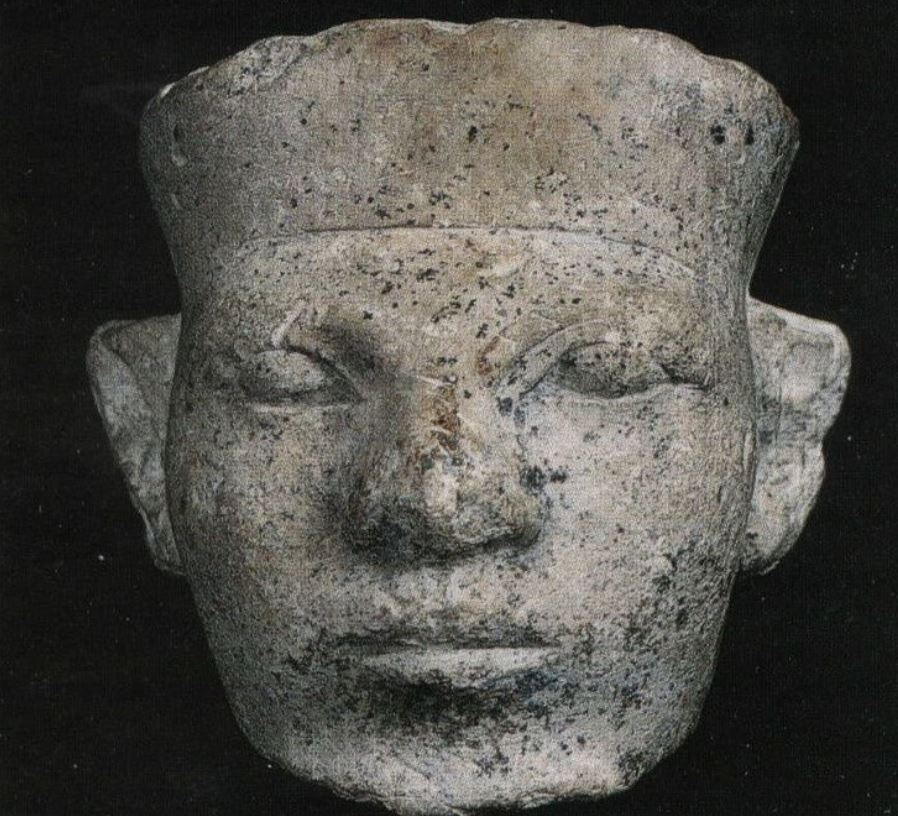
The first or second pharaoh of the 1st dynasty of Ancient Egypt. There are many theories and conjectures about the personality of Menes, but he can be perceived as the son of the pharaoh Narmer or Narmer himself – this fact is not exactly established.
The name Menes was first mentioned one and a half millennia after his alleged reign in the temple of the woman-pharaoh Hatshepsut , where it is written next to her name. Mena (Menes) acts as the founder of Egypt, from which all the pharaohs lead. In the Turin list, his name pops up twice: once as an ancestor of the pharaohs, then as dead pharaoh. Thus, they began to consider him as the first human ruler of the country after the era of the gods, who directly received power from the hands of the Choir . Menes appears even in the annals of Herodotus and Manetho, in Greco-Roman novels. Obviously Menes was indeed glorified, like Narmer.
It is noteworthy that the early royal annals and lists (for example, Palermo stone ) do not know the pharaoh with that name. Some scholars believe that Menes is the pharaoh of Narmer or Hor-Aha , since the terms of their reign coincide, moreover, in the annals of the Manetho, he is listed as the unifier of Upper and Lower Egypt, which Narmer is considered to be. The question remains open to this day. Some scholars reject the fact his existence.
By the middle of the 1st millennium mythical information about Menes turned him into a cultural hero in the memory of the Egyptians. The myth of Menes entered the Greek, later Roman historical tradition, Herodotus , Diodorus , Manetho , Pliny the Elder , Plutarch and Elian have messages about it. He is credited with the foundation of Egyptian statehood by uniting the warring kingdoms of Upper and Lower Egypt, and in particular the foundation of Memphis , the establishment of cults, the invention of writing (Pliny).
Legends of Menes
According to the late Egyptian and ancient traditions, Menes was an experienced military leader and an energetic politician. Apparently, he subjugated Lower Egypt (although we do not have data on his war with him) and merged both kingdoms, thus completing the long process of centralization of Egypt. As a clear result of his wise policy to pacify Lower Egypt, one can consider the record of the construction of a temple in Sais, dedicated to the goddess Nate, who was a deity patronizing the North.
His hometown was Tin, in Upper Egypt, but he did not lie close enough to the Delta to serve as his residence. Therefore, in this case, we can believe Herodotus, who claims that Menes carried out a large embankment, rejected the Nile, and built the Inebu-hedge fortress, which became the royal residence. A sanctuary was built south of the wall to the local god Ptah, which remained the patron god of this city throughout its ancient and long history. On the day of its discovery, Menes first performed the symbolic rites of the union of papyrus (symbol of the north) and lotus (symbol of the south). He crowned himself with white and red crowns, introduced the title “King of Upper and Lower Egypt”. Until the end of Egyptian civilization, they had the corresponding title, repeated this ritual at their coronation.
One legend, drawn on a stone stele in the temple of Amon at Thebes at the order of Tefnaht, father of Bakenranef (XXIV dynasty), cursed Menes for changing the life of the Egyptians for the worse, surrounded himself with luxury and splendor. According to another legend, Menes established the order of worship and temple rites. His name was also associated with the idea of the first legislator, the installer of cults.
The historical tradition that tells of the first Egyptian pharaoh was retold by Diodorus, but his narrative is fabulous, and therefore has a very dubious value. According to this ancient author, the king, hunting in Fayyum, was suddenly attacked by his own hunting dogs and escaped only because he rushed into the lake, where he was a Nile crocodile, which carried him to the opposite bank. In order to mark this supernatural salvation, he built a city in that place, and dedicated the lake to a crocodile. Diodorus also reports that the king built himself a pyramid in its vicinity and that the Egyptians first learned from this king how to worship the gods and live in a cultural manner; the latter, perhaps, is a peculiar echo of his activity to pacify the country after a long period of anarchy and bloodshed during the struggle for unification. George Stanley Faber in 1816 based on this story of Diodorus interpreted the word campsa as “ark” instead of “crocodile” and identified the Egyptian Menes with Noah and the history of the Flood .
According to the Manetho , quoted by African , the great king died in the 63rd year of his reign from wounds inflicted by a hippopotamus during a hunt. This story no longer seems as incredible as the previous one, for we know that the hippo hunt was a popular entertainment that the ancient Egyptian kings allowed themselves to. It is possible, however, that this story and the story of Diodorus are just two versions of the same legendary plot.
Sources:
 History of the Ancient East. The origin of the oldest class societies and the first foci of slave civilization. Part 2.
Jürgen von Beckerath. Handbuch der ägyptischen Königsnamen. - München: Deutscher Kunstverlag, 1984.
Mina, Egyptian Pharaoh // Encyclopedic Dictionary of Brockhaus and Efron : in 86 volumes
Menes // The Real Dictionary of Classical Antiquities 
