


Early years
Ugolino was born in Anagni. His date of birth varies in sources between 1145 and 1175 years. He was probably born around the year 1170. He was educated at the universities of Paris and Bologna.
Ugolino was elevated to the rank of Cardinal Deacon of the Church of Sant Eustacio by his uncle, Pope Innocent III in December 1198. In 1206, he was promoted to the rank of Cardinal Bishop of Ostia and Velletri. He became dean of the Holy College of Cardinals in 1218 or 1219. At the special request of St. Francis in 1220, Pope Honorius III appointed Ugolino the Cardinal Protector of the Franciscan Order.
As Cardinal of Ostia, he gained a wide wide circle of acquaintances, among them, in particular, the then Queen of England Isabella of Angouleme.
Papacy
Gregory IX was at an advanced age when he was elevated to the papal throne in 1227x. He took the name “Gregory”, because he was proposed as a candidate in the monastery of St. Gregory.
Being the successor of Honorius III (1216–1227), he followed the traditions of Gregory VII (1073–1085) and Innocent III. continuing to strengthen the Roman throne.
Inquisition
Alarmed by the spread of heresies in Spain and France, as well as the mob violence against heretics, in 1231 Gregory IX established the papal inquisition to streamline proceedings against heretics, although he did not approve of the use of torture as an instrument of pressure. In 1232, the pope passed the Inquisition into the hands of the Dominicans.
Northern Crusades
Gregory IX approved the Northern Crusades of the Teutonic Order, the purpose of which was the baptism of the Baltic pagan peoples, and which led to the attempts of the Catholic colonialists to seize the lands of Pskov and Novgorod principalities.
On January 23, 1229, he sent messages to Riga, Lubeck, Sweden, to Gotland with an appeal to begin the trade blockade of Russian lands “until they cease all hostile actions against the newly baptized Finns.” It was recommended to prohibit the supply of weapons, iron, copper, lead, horses and food to Russia. It is noteworthy that papal messages were issued at a time when severe hunger broke out in Novgorod, while German merchants did not obey the pope and ultimately rescued the Novgorodians. On February 3, 1232, the pope issues a message to his legate Baldwin Alnsky forbidding peace or entering into agreements with pagans and Rutenus.
In the bull of November 24, 1232, Gregory IX asked the Livonian brotherhood of the sword to send troops to protect half-pagan Finland. Which was baptized by Swedish bishops, from being colonized by Novgorodians.
In 1234, the troops of the Livonian Order were defeated by the Novgorodians, led by Prince Yaroslav Vsevolodovich. In the battle of Omovzh near Yuryev. But already in 1237, Gregory IX turned to the Swedes with an appeal to organize a crusade in Finland.
Messages from the pope contributed to the consolidation of the Catholic colonialists in attempts to conquer the territories of the Novgorod and Pskov principalities after the lands of Livonia, which were part of the territory of the Principality of Polotsk, were torn away.
Other Events From His Rule
In 1234, in the Decretals treatise, he set forth the doctrine of “perpetua servitus iudaeorum” – the eternal slavery of the Jews. According to him, the followers of the Talmud should remain in a state of political slavery until the Day of Judgment. In 1239, under the influence of Nikolai Donin. a baptized Jew, Gregory ordered all copies of the Talmud to be confiscated. After a public debate between Christian and Jewish theologians, 12,000 Talmud manuscripts were burnt on June 12, 1242 in Paris.
Gregory was a supporter of mendicant orders, in which he saw an excellent tool to counter the craving for luxury inherent in many clergymen. He was a friend of St. Dominic, as well as Francis of Assisi.

Pope canonized Francis of Assisi and many other saints popular in Catholicism, including Elizabeth of Hungary and Anthony of Padua.
Conflict with Frederick II
During his coronation in Rome on November 22, 1220, Frederick II vowed to go to the Holy Land in August 1221. Gregory IX constantly reminded him of this vow, because the emperor was in no hurry to fulfill it. This has contributed to their relationship. As a result, the emperor nevertheless went to the Holy Land, but at that time Reynald. the imperial governor of Spoleto. invaded the Papal Region. In June 1229, Frederick II returned from the Holy Land, defeated the papal army, which Gregory IX sent to invade Sicily, and entered into an open conflict with the pope.
Gregory IX and Friedrich came to a truce, but after the defeat of Frederick the Lombard League in 1239, the likelihood that he could dominate all of Italy turned into a real threat. In 1239, Gregory IX excommunicated him from the church. The war has begun. An attempt to organize a cathedral to convict the emperor in 1241 was thwarted by the actions of the imperial son Enzio, who intercepted ships with bishops at sea. The emperor’s army approached Rome, while the Mongols reached the borders of Germany.
The fight ended only with the death of Gregory IX on August 22, 1241. Innocent IV, who declared a crusade in 1245 to eliminate the threat of Hohenstaufen, became his successor.
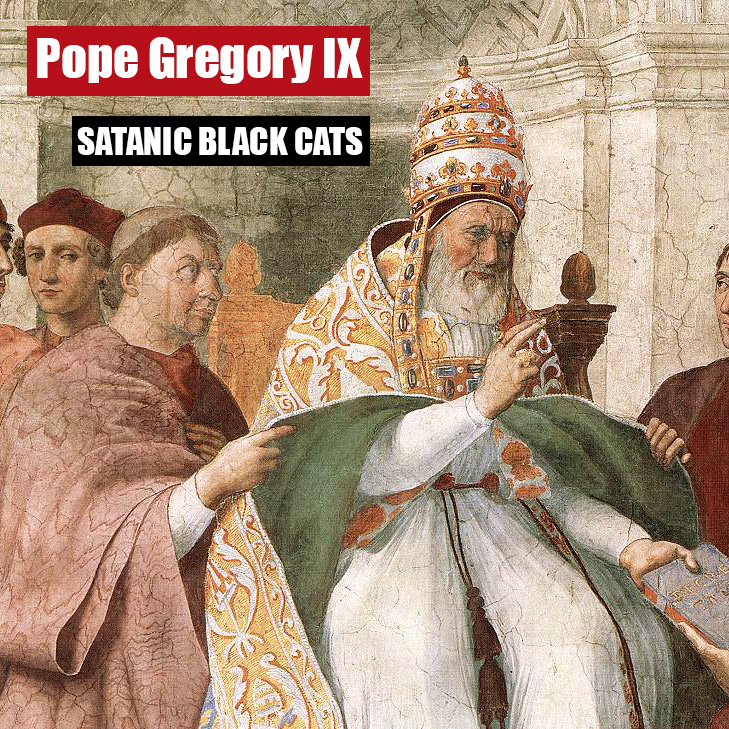
Bull Gregory Vox in Rama (1234), published with the aim of organizing a crusade against peasant sting communities in northern Germany who did not want to pay tithing. is the first official church document that declares the black cat the embodiment of Satan. It is possible that this bull, which encouraged the extermination of cats, became one of the indirect causes of the plague epidemic that came from Central Asia – in such conditions, the number of rats transmitting the plague sharply increased.
Sources:
Vasiliev P.P. , Korelin M.S. Gregory, popes // Encyclopedic Dictionary of Brockhaus and Efron

