


Typography was invented twice: once in China and Korea and in medieval Europe. In China, printing was invented, according to some data (Julien, “Documents sur l’art d’imprimerie”), in 581 AD. and according to Chinese sources – between 935 and 993 years. The first accurately dated print is a Chinese xylographic copy of the Buddhist Diamond Sutra, published in 868. A printed amulet, dated to 704–751, was found in 1966 during excavations of a temple in Gyeongju, Korea.
Piece printing
The technique of box printing to reproduce text, drawings, and images was widely used throughout East Asia. It originated in ancient China as a method of printing on textiles, and then on paper. The earliest preserved specimens printed on the fabric are Chinese and date from no later than 220 AD. The nearest Western samples belong to the IV century and belong to the Ancient Egypt of the Roman rule.
In East Asia
The earliest surviving engravings originate from the Chinese era of the Han dynasty (before AD 220), they were used to imprint on silk tricolor flower images, and the earliest example of an engraving on paper, also Chinese, dates from the middle of the seventh century.
In the ninth century, printing on paper was already professionally practiced; it was this period that the first surviving full printed book, the Diamond Sutra (now in the British Library ), dated. In the tenth century, 400,000 copies of some sutras and paintings were printed, Confucian classics were published. An experienced printer in one day could print up to 2,000 sheets consisting of double pages.

From China, typography has spread to Korea and Japan, which used Chinese logograms; Chinese printing techniques were also used in Turfan and Vietnam using other fonts. However, unlike another invention – paper, the technique of printing has never been borrowed by the Islamic world.
In the Middle East
Piece printing on fabric appeared in Roman Egypt by the fourth century. Woodcut, called “tarsh” in Arabic, was developed in Arabic Egypt in the 9th — 10th centuries, being used mainly for prayers and written amulets. There are some reasons to believe that these prints (engravings) were made from non-wood materials, possibly from tin, lead or clay. The methods used seem to have very little influence outside the Muslim world. Although Europe adopted the printing of wood engravings from the Muslim world, originally for an imprint on fabric, the technique of metal wood engraving in Europe remained unknown. The woodcut later fell into disuse in Islamic Central Asia after a rolling type seal was adopted from China.
In Europe
For the first time in Christian Europe, the imprint technique on fabric appeared around 1300. Images imprinted on fabrics for religious purposes could be quite large and complex, and when the paper became relatively easily accessible around the year 1400, small prints on religious themes and paper playing cards immediately spread. Mass production of printed paper began around 1425.
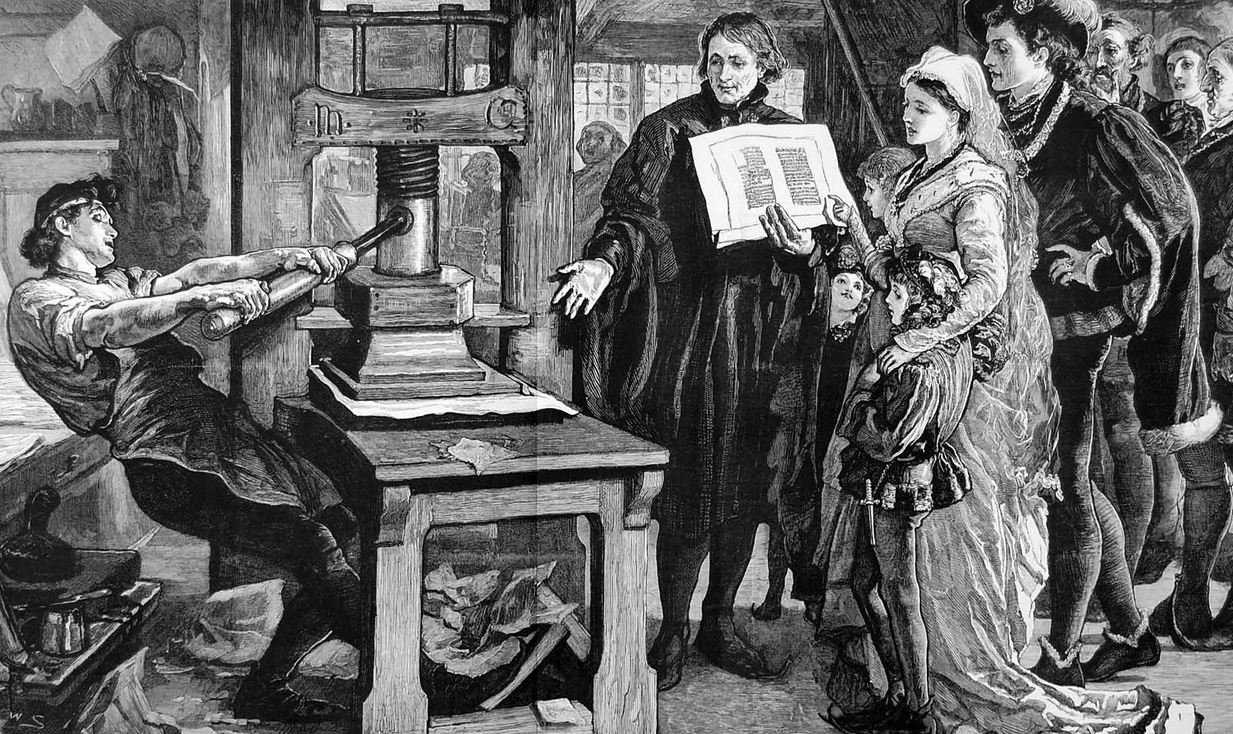
1445 is considered the year of the invention of printing. The essence of the invention was that John Gutenberg proposed to use separate metal letters for typing – letters that were arranged in the right order in special cells. The letters were manually painted and then pressed onto a piece of paper in the machine. The result is a print of the book page. The machine, created by Gutenberg, it was possible to make 100 prints of one sheet per hour. The first printed books were the Bible and the Psalter, published in Latin.

