


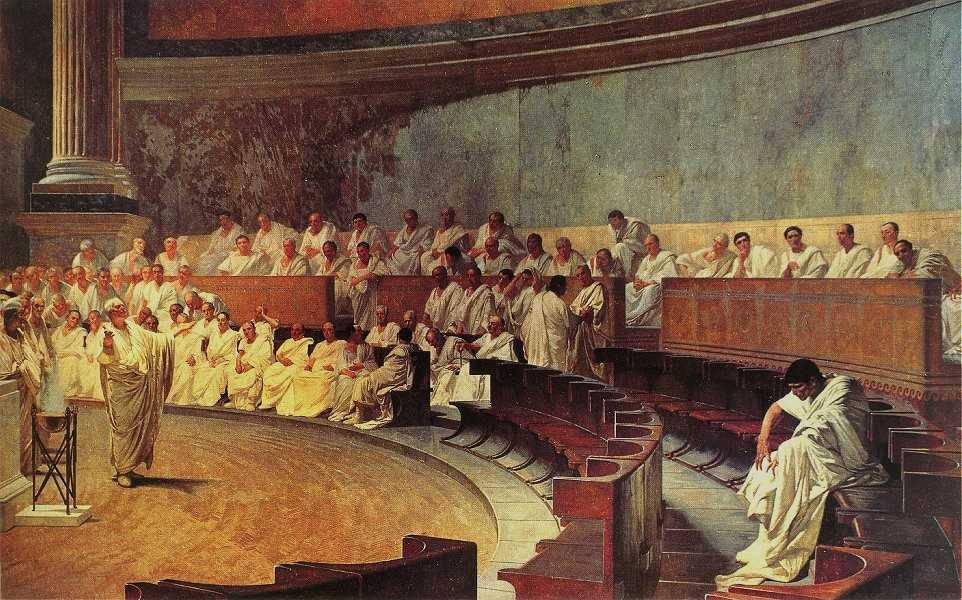
Senate in the era of the Republic
With the establishment of the republic, the Senate, along with the magistrates and the people’s assemblies ( comitia ), became an essential element of public life. Former magistrates were part of the Senate for life – thus, the political forces and state experience of Rome was concentrated here.
Members of the Senate were divided into ranks in accordance with the previous positions. During discussions, senators received the word in accordance with these ranks. At the head of the Senate was the most honored, the first of the senators – princeps (princeps senatus). Also, the senator was always required diligent behavior, education, attention and responsibility.
In the period of the republic during the class struggle of the plebeians with patricians ( V – III century B.C.), The power of the Senate was somewhat limited in favor of the comitia (public assembly).
In the III — I centuries B.C. The Senate tentatively considered the bills proposed for voting in committees, they owned the highest leadership in military affairs, foreign policy, finances and state property, supervised religious cults, the right to declare a state of emergency, etc. The Senate approved laws and election results, and supervised the activities of the magistrates. Thus, the Senate actually exercised leadership of the state.
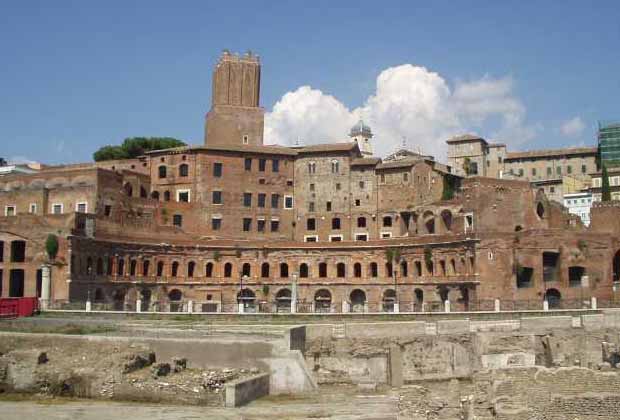
Senate decrees had the force of law, as well as resolutions of the national assembly and assembly of plebeians – a plebiscite.
According to Polybius, decisions in Carthage were taken by the people (plebs), and in Rome – by the best people, that is, by the Senate. And this is despite the fact that according to many historians, Carthage was ruled by oligarchy.
Senate in the era of the Empire
During the period of the empire, the power of the senate was increasingly limited, concentrating in the hands of the emperor, although formally the senate continued to be considered one of the highest state institutions. In fact, the Senate has become a meeting of representatives of noble families, which does not have much political influence. Senate decrees retained the force of laws, but were usually adopted at the initiative of the emperor. Beginning with Octavian Augustus, the actual emperor of Rome bore the title of “princeps” – that is, “the first of the senators.”
Under Diocletian (end of III century ), the senate was turned into the city council of Rome, and under Constantine ( 4th century ) the senate was established in Constantinople – the “second Rome”, equalized with the Senate of Rome.
Senate after the fall of the Western Roman Empire
Even after the fall of the Western Roman Empire, the Senate in Rome continued to function under barbaric rule, retaining influence at the city level. For example, an episode is known when “ Theoderich sent Legate Festus, the head of the Senate to Emperor Zeno, hoping to get royal vestments for himself”. However, in the middle of the 6th century, the number of Roman noble families decreased as a result of the wars between Ostrogoths and Byzantium, as the city passed from hand to hand, and the barbarians took representatives of the nobility as hostages. The last mention of the Roman Senate dates back to 603: in the Gregorian Register it is mentioned that this year the Senate welcomed the opening of the statues of Emperor Phoca and his wife Leonty. It is assumed that, as an institution, the Senate disappeared around 630, when, with the permission of the Byzantine Emperor Heraclius I, the Basilica of St. Adrian was built in the Roman curia.
Size
The number of senators has changed several times:
Originally 100
At the time of the early republic (up to 88 B.C.) – 300,
Since the time of Sulla – 600,
At Caesar – 900,
From the time of Augustus – again 600,
In the period of late antiquity – 2000.
Sources:
Rostovtsev MI Roman Senate // Encyclopedic Dictionary of Brockhaus and Efron
Talbert RJA The Senate of Imperial Rome
Dementieva, V.V. The state-legal structure of ancient Rome
Chekalova A. A. Senate and senatorial aristocracy of Constantinople

