


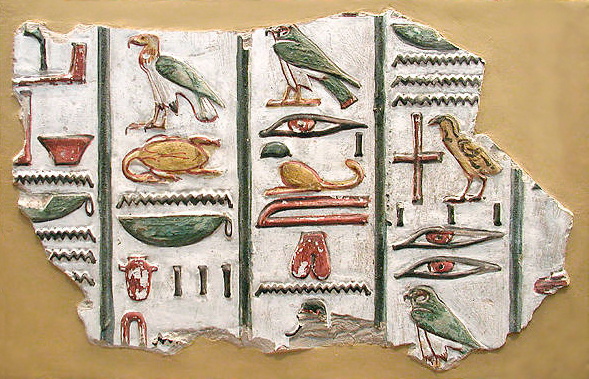
Many Egyptian historical monuments still standing, are covered in writings known as hieroglyphs. Hieroglyphs are a system of pictorial writing that the ancient Egyptians used to record events and stories. They can be read as a picture, as a symbol of an image, or as a symbol for the sound related to the image. The word hieroglyph, meaning “sacred carving” was used by the Greeks to describe the writings on the monuments in Egypt. However, in the 19th century, the term was expanded to other writings, like those of the Indus civilizations and the Hittites.
Development
The first hieroglyphs can be dated around the 4th millennium BC on pottery. But in the Early Dynastic Period (2920-2575 BC), hieroglyphs began to conform to certain standards. At the start of the Old Kingdom, hieroglyphs are found on stone monuments and reliefs. They are added on walls of temples, tombs, gravestones, statues and coffins. Hieroglyphs were used for historical purposes, like records of battles. They were used for writing music, many varied documents, but also for religious purposes: like rituals, myths, hymns, prayers etc. However, these were not suitable for everyday use, so they were only used as decorative writing, since they took a lot of time to be written. The hieratic script was developed for much faster and everyday use. Not everyone knew how to write in ancient Egypt. The privilege of learning to write and read was limited only to the officials, priests and craftsman who were making inscriptions.
The hieroglyphs were still used in the Macedonian and Roman period of Egypt, but the circle of people who used and understood them declined. During this period, only the priests studied the hieroglyphs. However, all this changed when Egyptians converted to Christianity. In the 2nd and 3rd century AD, traditional polytheistic religion was replaced with monotheistic Christianity, so Egyptians were forced to incorporate the Greek alphabet into the Egyptian language. The knowledge of hieroglyphs then quickly declined and disappeared. The last writing using hieroglyphs is during the rule of Theodosius I in 394, on the island of Philae.
 The original number of hieroglyphs was approximately 700, but multiplied later. The writings were written from right to left, but when decorating certain surfaces like doors or walls, the writings could also be in vertical form.
Decipherment
Hieroglyphs disappeared in the middle ages. The first interest for them was in 1422, when a manuscript of Horapollon was brought to Florence. The first attempt to decipher them was made by the German scholar Athanasius Kircher (1602-1680). He attempted to decipher them into the Coptic language, believing that the hieroglyphs were an earlier stage of that language. He also believed that the signs recorded phonetic values (he was correct).However, he couldn’t decipher it, with the exception of a single character.
In 1799 a stone was discovered by members of Napoleon’s Expedition in Egypt. The stone was discovered near Rashid (Rosetta) on the Mediterranean coast, and had three scripts: hieroglyphic, Greek and demotic. The Greek text stated that the translation was same in all three scripts. This was a big step forward for scholars. Johan David Akerblad and Thomas Young had initial success deciphering hieroglyphs.
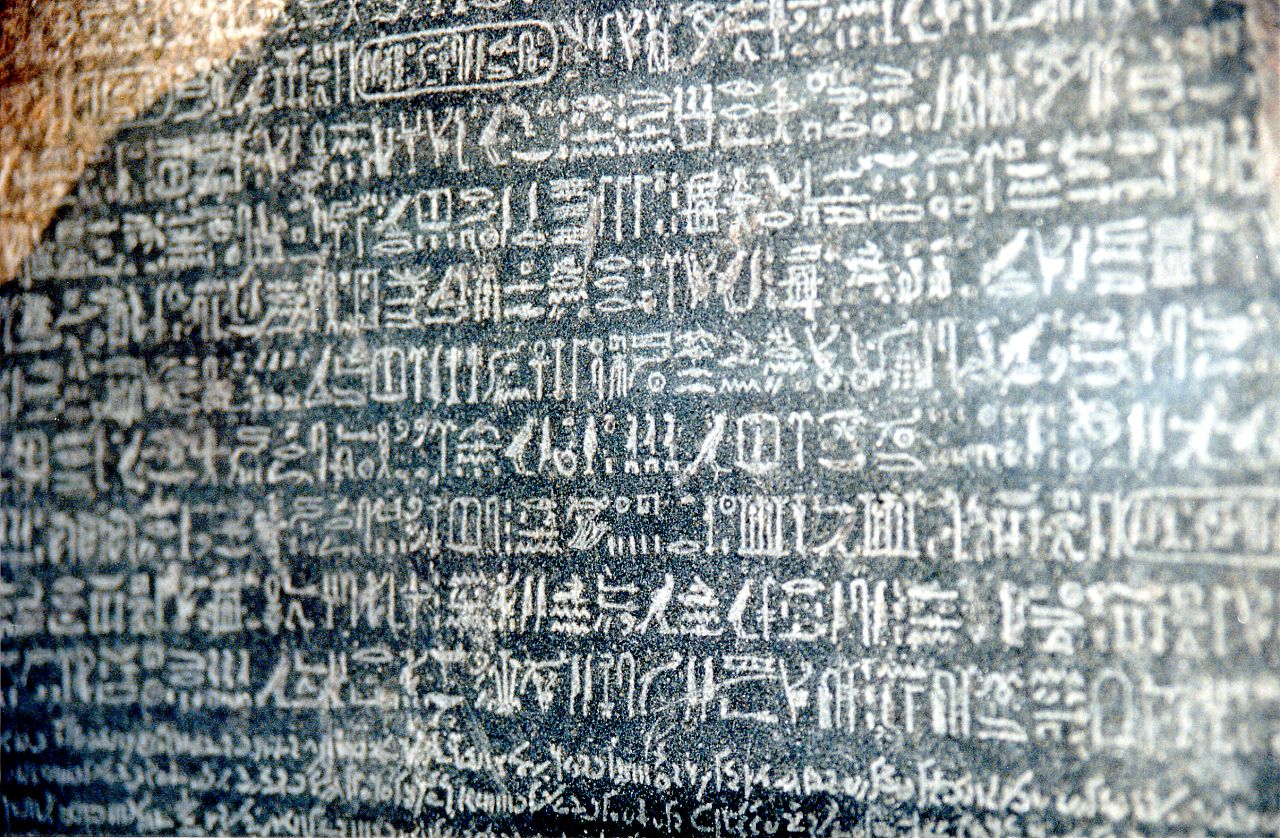
Complete deciphering was done by the French Jean-Francois Champollion (1790-1832) in 1822. He determined that hieroglyphic writing did not represent a system of symbols, but a phonetic script. He started deciphering from Ptolemy and Cleopatra, and added the hieroglyphic spelling of Ramses name. He determined the phonetic values of the signs, allowing him later to learn many more Egyptian words. This was a big breakthrough. Much of what we know about ancient Egypt today can be traced by hieroglyphs in the temples, tombs or written on papyrus. This would not be possible, if not for Champollion.

