


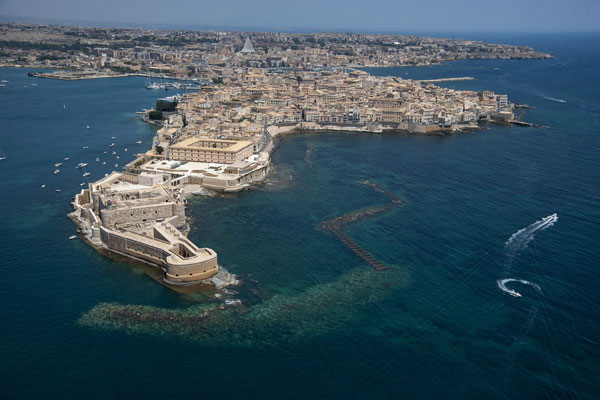
After an unsuccessful struggle with the Carthaginians (406–405 B.C.), the Hermokrat party again appeared on the scene and, by the way, Dionysius, the favorite of the Syracuse crowd, rose. Having managed to deftly accuse his comrades in command of being bribed by the Carthaginians, he achieved the sole command of the army and soon after that seized government power. Under Dionysius I (405–367 B.C.), Syracuse reached the peak of its power and glory of the first Greek city in the west.
The successor of Dionysius I, his son Dionysius II Jr. (367–357 and 354–343 B.C.), was an inept ruler. Under him a revolution occurred, the culprit of which was Dion, who sought to introduce popular rule. Three years (357–354 B.C.) Dion retained power, but died at the hands of murderers, after which Dionysius again fell into tyranny. Citizens of the city, torn apart by insurrections and the struggle of the parties, appealed for help to their metropolis, Corinth, who sent Timoleont to restore order.
Having freed Syracuse from Dionysius and the Carthaginians, Timoleon ruled from 343 to 337 B.C. e. and again returned the Sicilian capital to its former brilliance and power. Having fulfilled the task entrusted to him, Timoleon resigned his power and retired to private life.
After his death, the management of the city was entrusted to the 600 best citizens (oligarchs), but in 317 B.C. Agathocles after the victory over Carthage seized power and restored the horrors of tyranny. After his death (289 B.C.), a new period of unrest and despotism began, and if Pyrrhus had not appeared in 278 B.C. in Syracuse, all of Sicily would have fallen under the power of the Carthaginians.
Under Hieron II (270-216 B.C.) the city lived quite prosperously and in relative peace. Hieron was a kind and skilful ruler; his financial legislation was maintained even after the Romans conquered Syracuse.
The War

In the struggle of the Romans with the Carthaginians, Hieron II was a faithful ally of Rome. Hieron’s grandson, Hieronymus, preferred an alliance with Carthage, but soon fell victim to a conspiracy caused by his arrogance and cruelty. The government tried to take Adranodor, son-in-law of Hieronymus, and then the brothers Hippocrates and Epicides. The ensuing troubles were suppressed by the Carthaginians, who, under the pretext of freeing the city from the tyrants, secured the favor of the masses. In 214 B.C. Marcellus approached the city with the Roman army and besieged it from the sea and land. In 212 B.C. he seized Epipolam and Tikhaya, and in the autumn of the same year, when a plague forced the Carthaginian fleet to sail to Africa for new reinforcements, Ahradina and the Island surrendered. The city was looted by the soldiers; most of the monuments of art were transported to Rome. When taking Syracuse, the great mathematician Archimedes perished.
Becoming after 212 B.C. a simple provincial Roman city, Syracuse did not lose their former glory and were the residence of the Roman governor in Sicily.
During the second triumvirate, when Sextus Pompey took possession of Sicily, the city again suffered pogroms; but Augustus in 21 B.C. transferred here new settlers, the quarters in which the most remnants of Roman architecture and traces of Roman life remained. Under the emperors, Syracuse continued the quiet life of a cultural, glorious Greek city; they kept their council and had their own magistrates.
Sources:
High MF The history of Sicily in the archaic era. Early Greek tyranny of the end of VII – mid-V
Graham A. Western Greeks – in the book: “ Cambridge history of the ancient world
Obnorsky N. P. Syracuse, Greek colony // Encyclopedic dictionary of Brockhaus and Efron
Göller, “De Situ ex orig origine Syracusarum”
Schubring, “Achradina. Ein Beitrag zur Stadtgeschichte von Syrakus ”
him, Die Bewässerung von Syrakus
S. Cavallari, A. Holm, Cr. Cavallari, “Topografia archeologica di Siracusa”
B. Lupus, “Die Stadt Syrakus im Altertum”
Muess, “De Syracusanorum rerum statu etc.”

