


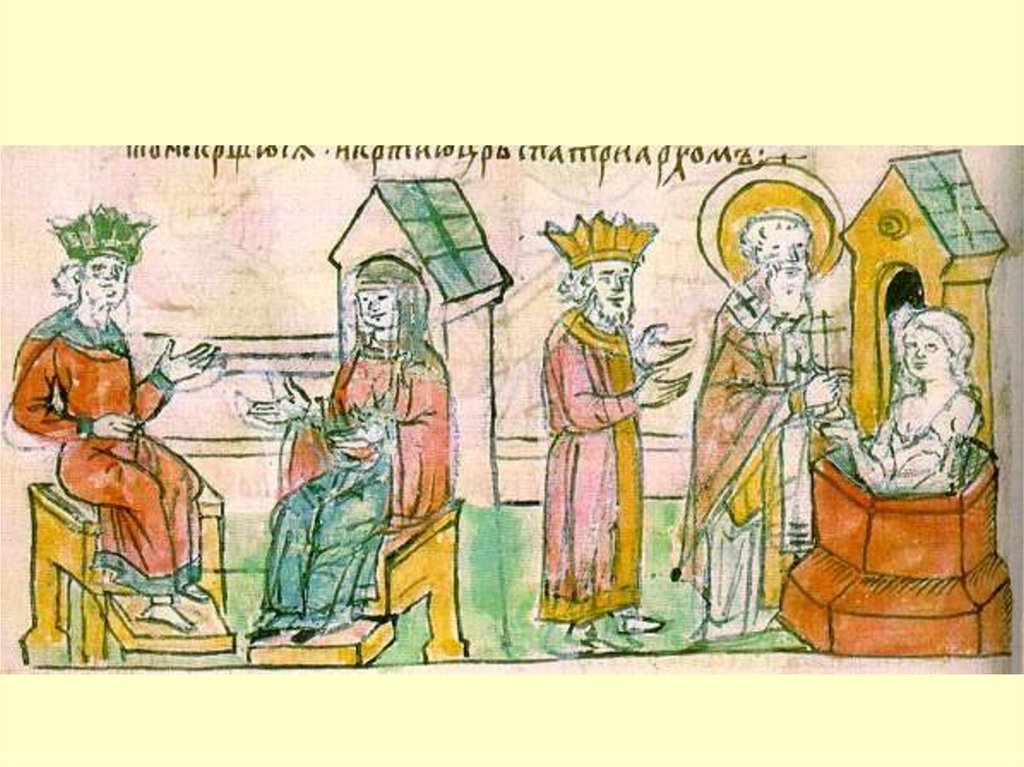
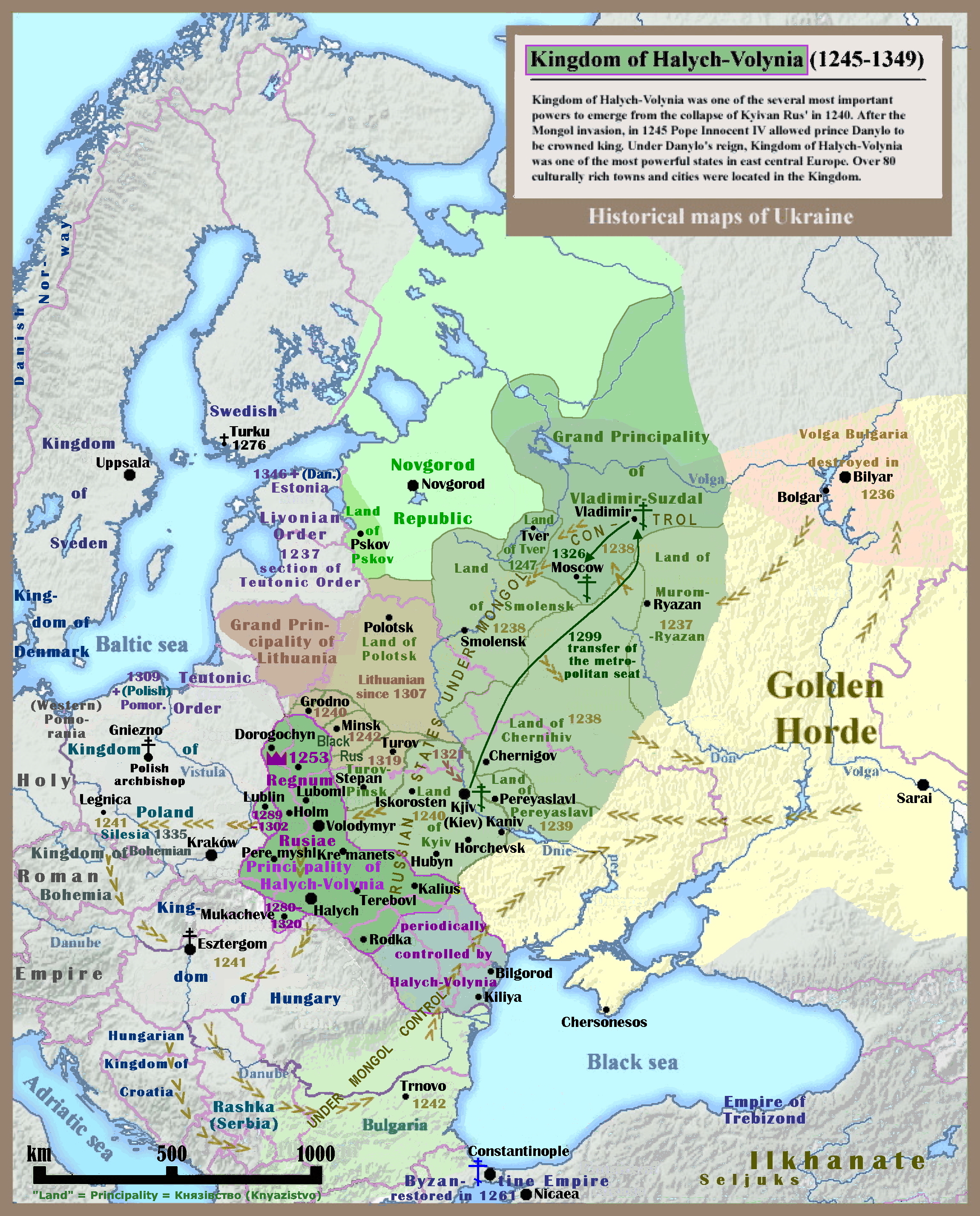
In the second quarter of the twelfth century, the single state broke up into independent principalities. The chronological beginning of the period of fragmentation is considered by the modern historiographic tradition in 1132, when after the death of Mstislav the Great, the son of Vladimir Monomakh, the power of the Kiev prince ceased to recognize Polotsk (1132) and Novgorod (1136), and the title itself became an object of struggle between various dynastic and territorial unions of Rurik. The chronicler under the year 1134 in connection with the schism in the medium of Monomakh wrote down “the whole Russian land was torn.” The outbreaks of civil strife did not concern the greatest reign, but after the death of Yaropolk Vladimirovich (1139), the next Monomakhovich Vyacheslav was expelled from Kiev by Vsevolod Olgovich Chernigovsky. Russia disintegrated into separate principalities, including (on the territory of modern Ukraine) the principality of Kiev, the Chernigov principality, the principality of Galicia, the Vladimir-Volyn principality, and partly the Turovo-Pinsk principality, as well as the Pereyaslav principality.
In addition, at the end of XI and throughout the XII century, the raids of the Polovtsi, which replaced the Pechenegs, migrated to the Balkans, and became more frequent. For many decades, the southern Russian princes could not cope with the Polovtsi by undertaking a number of unsuccessful campaigns and suffering sensitive defeats (the battle on the Alta, the battle on the Stugne River, etc.) The Polovtsi ravaged many Russian cities, often approaching Kiev itself, plundering the Pechersk Lavra.
Historians proceed from the fact that over the course of the 12th century, part of the population of the southern Russian principalities, due to the constant threat emanating from the steppe, moved to the north, to a more peaceful Rostov-Suzdal land, also called Zales’y or Opol’ye. The migrants from the populous south quickly constituted the majority in this land and assimilated the rare Finnish population. The chronicles and archaeological excavations testify to the massive Russian migration throughout the 12th century. The period and the rapid growth of numerous cities in the North-East of Russia (Vladimir, Moscow, Pereyaslavl-Zalessky, Yuryev-Opole, Dmitrov, Zvenigorod, Starodub-on-Klyazma, Yaropolch-Zalessky and others) fell on this period. The names of new cities were often copied names of cities in the south of Russia).
In 1169, the grandson of Vladimir Monomakh, Vladimir-Suzdal Prince Andrei Bogolyubsky sent troops led by his son Mstislav, to seize Kiev . The city was brutally plundered, Kiev temples were burned, residents were taken captive.
In 1199 Roman Mstislav united the Galician and Volyn principalities, his descendants were finally established in the Galician-Volyn principality in 1239. After the invasion of Batu 1237-1241 and the ruin of 1299, Kiev fell into neglect.
From the XI century in the territories south of the ancient Russian principalities were Polovtsian nomads. In the first half of the 13th century, these lands became part of the Golden Horde.
Already in the second half of the XIII century, there was a difference in the position of individual principalities, which would determine their fate in the future. The position of the principalities of the Ukrainian lands – Kiev , Pereyaslavsky , Chernigov and Galitsko-Volynsky was largely determined by the events before the Mongol invasion. The forty-year war (1205–1245) greatly exhausted their strength. Border Kiev, Pereyaslavskaya and Chernigov-Seversky land became easy prey for Batu. These principalities have lost the pace of evolution compared with their neighbors. The princely elite, terrorized by the Mongols, degraded, there was a decline in urban life, and the continuous division of the land-principalities intensified. In contrast, the Galician-Volyn princely branch, which emerged victorious from the war of 1205-1245, succeeded in laying the foundations of its own powerful state, which has steadily existed for another century.
Sources:
Efimenko A. Ya. The history of Ukraine and its people
Subtelny O. Ukraine: history
Yaroslav Gritsak . Formulary Modern Ukraine Nation
Mikhailo Grushevsky. History of Ukraine-Rus.

