


Who is this Vercingetorix ?
Vercingetorix was a tribal chieftain of the Gallic Celtic Arverni tribe who attempted to stop the encroachment of Romans into his territory, Provence, in present day France, from 53 to 52 b.c.e. The Roman leader, Gaius Julius Caesar (100–44 b.c.e.), and his lieutenant Quintus Atius Labienus (100–45 b.c.e.), lost early engagements against Vercingetorix, who against all odds had managed to unite the generally warring tribes in Provence. This temporary alliance allowed Vercingetorix the upper hand. He retreated by using hit-and-run tactics within the natural boundaries of Provence that were unknown to the Romans. To prevent the Romans from finding sustenance, they scorched over 20 towns.

In the spring of 52 b.c.e.
In the spring of 52 b.c.e. Caesar ordered siege fortifications to be built in order to capture the capital of Avaricum, present-day Bourges, which contained huge supplies of grain. Through unrelenting rain his troops built two 80-foot towers with more than 300-foot ramps in one month. The Gauls tried to sabotage the Roman siege works unsuccessfully. In the end 800 Gauls fled to Vercingetorix. The angry Romans massacred the 40,000 remaining inhabitants of Avaricum. Caesar, tired of the ceaseless and unproductive skirmishes and battles, had no desire to face the fierce Celtic tribes and decided to starve them out before reinforcement could reach Alesia. Caesar had his Romans build encircling fortifications around the Arverni stronghold at Alesia, near present day Dijon, from which Vercingetorix had planned to fight and in which he was ultimately trapped.

Caesar had a plan
Caesar once again used siege warfare to obtain his objective. He had his troops build a two-walled perimeter that would keep the Arverni and the Romans within close contact. The outer ring held the Romans,who besieged the Arverni. Modern-day excavators found the first wall to be 13 miles long with an 18-foot ditch that was meant to starve the Arverni. The second wall faced pointed stakes that could easily impale unsuspecting tribesmen. Yet another wall, 9 feet high and full of breastworks of earth, was constructed. In addition, every 130 yards, observation towers were erected. Two siege towers were built, each 80 feet high, that could contain ramparts of varying lengths. Vercingetorix tried to destroy the walls and often had skirmishes with the Romans, but to no avail.
/about/vercingetorix-surrendering-to-julius-caesar-after-the-battle-alesia-593279296-589a26115f9b5874ee8d6563.jpg)
Ether fight or Die
His last attempt to alleviate the siege led to failure, his men fell onto the spikes, and the Romans killed many Gauls. Alesia was so well fortified by the Romans that Vercingetorix was given no choice when reinforcements failed to arrive. The war council in Alesia decided to wait for the end. The Arverni were slowly starving, so Vercingetorix released the women and children from his stronghold, hoping Caesar would take pity and treat them as prisoners, but he refused, and the women and children perished. Caesar won the five-day Battle of Alesia because the tribes under Vercingetorix were poorly organized and some betrayed their leader.

Surrender and Death
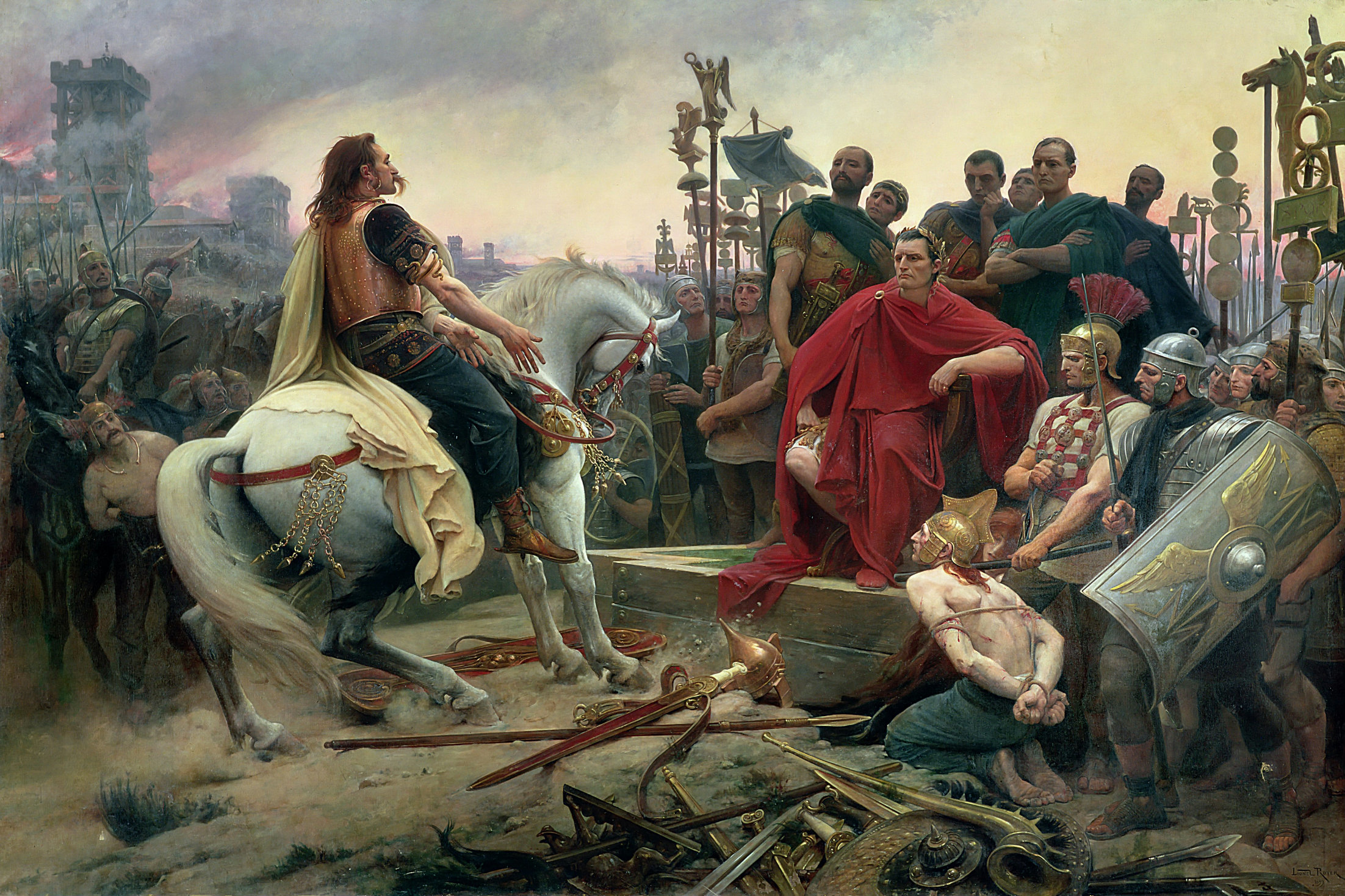
Various stories surround the surrender of Vercingetorix. One story relates that Vercingetorix and several tribal leaders simply surrendered to Caesar. The second story, written by Plutarch at least 100 years after the event, accounts that Vercingetorix rode out of Alesia in a stately fashion and around Caesar’s camp, removing his battle armaments and surrendering with theatrical gestures
before kneeling to him. His death is also shrouded in debate. One historian claims he was killed shortly after his surrender. Another argues that for the next five years Vercingetorix was Caesar’s prisoner in the Tullianum in Rome. Vercingetorix allegedly became a showpiece and was paraded around various Roman cities for five years in between stays at the Tullianum prison in Rome. Vercingetorix was publicly beheaded in Rome in 46 b.c.e. The Celtic tribes never fought again in present day France and were absorbed into the Roman Empire.

