


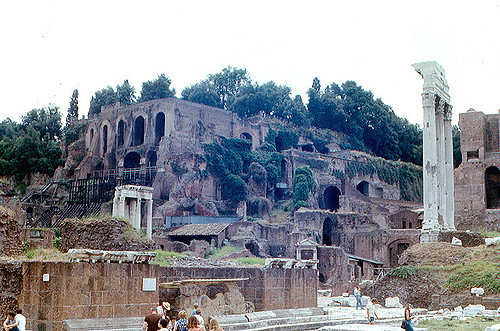
Initially, the settlements that emerged on the territory of the city were divided settlements, in which the community played the main role. In the VIII century B.C. a group of primitive settlements appeared in Latia, on the hills of Palatin, Esquilina, Ceelia and Quirinale. The fortified villages were tribal villages located on the tops and upper slopes of the hills. The marshy lowlands between them became habitable only with time, when people began to drain them. The inhabitants of the Palatine Hill burned their dead, like other Latin tribes, while on the Quirinal hill, the deceased were buried in the ground, in wooden decks. Therefore, it is believed that the Palatine and part of Celia belonged to the Latins, and the northern hills – to the Sabines. The first Roman settlers lived in round or rectangular huts, built on a wooden frame with clay plaster; their main occupation was cattle breeding. Not only hills, but also lowlands between them, were mastered for economic purposes.
The united Roman community was formed by the merger of small towns. During the VII century B.C. neighboring villages merged into one. The inhabitants of Esquiline Hill and Palatine Hill, and also the valley of Subura lying under it, were the first to unite. On the Palatine was built the fortress of this new village. The inhabitants celebrated it annually with the festival of “Septimontium”, the name of which comes from seven stops of the festive procession. Subsequently, this name gave reason to believe that Rome originated on seven hills. Soon the village expanded with the accession of the Quirinal communities. In the same VII century B.C. Tselius was populated by Etruscans and was also included in the emerging city. At the beginning of the VI B.C. the Capitol becomes inhabited, and the lowland between the hills – the common marketplace – the forum – the future center of the social and political life of the city of Rome. A general fortress was built on the Capitol. At that time, the people of Rome consisted of three tribes, corresponding to the Athenian ones. Their later names are known: titles, frames and lucers; It is believed that the tribes corresponded to the ethnic structure; so the frames are the Latins, the Titsii the Sabines, and the Luthers the Etruscans. On the basis of the tribes, equestrian detachments were recruited; military democracy was a probable way of governing the Roman community, and the main political institution was comitia – a collection of soldiers. The same period is the draining of swamps in the lowlands between the hills – this led to the development of lowlands and the construction of a central market – the Forum. Restoration of the drainage system of Rome by Napoleon Bonaparte allowed to begin excavations of the forum.

Thus, by uniting various villages into a single community, Rome arose. At the dawn of its existence, the future capital of a huge empire was an alternation of crooked streets winding through low hills and dampish lowlands – a permanent breeding ground for malaria. The dwellings of the first Romans were very unsightly: they were not even houses, but scattered without any plan huts made of branches, smeared with clay and covered with straw or reeds. But the city was in a convenient place. The hills created a natural defense against enemies, a navigable river flowed alongside, salt could be mined at its mouth, there were a lot of forest around, and lush pastures along the hillsides.
The inhabitants of ancient Rome were engaged mainly in cattle breeding, agriculture played a smaller role. At first, hunting and fishing, as well as salt mining, were of considerable importance.
Sources:
Momigliano A. The origins of Rome // The Cambridge Ancient History. Vol.7, part. 2. The Rise of Rome to 220 BC
Badak A.N., Voynich I.Ye., Volchek N.M. and others. “Ancient Rome”
by ed. A. G. Bokchanov and V. I. Kuzishchina. “The History of Ancient Rome”
L. Kofanov. 2001: The character of royal power in Rome of the VIII — VI centuries. BC

