


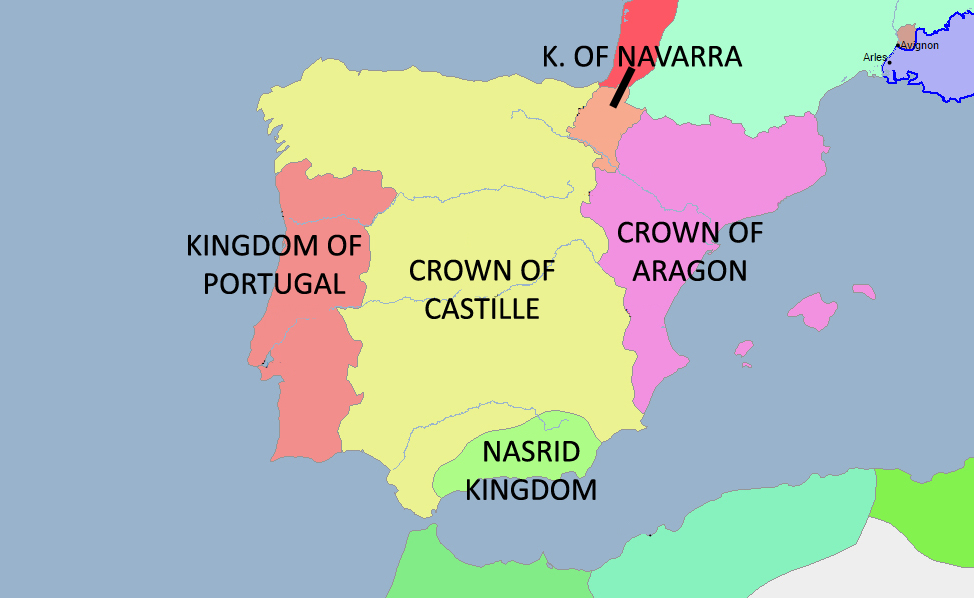
The kingdom of Aragon was a kingdom in northeastern Spain, roughly coextensive with the modern autonomous community of Aragon. The name Aragon comes from the river Aragon which flows by the city of Jaca. The name might be of Bosque origin (Aragona/Haragona- good upper valley), but there is a possibility that the name came from the early Roman province of Hispania.
Aragon was a Carolingian feudal state. Later, in the first half of the 9th century it became vassal state of the kingdom of Pamplona (Navarre). The kingdome dates back from 1035, when Sancho III the Great of Navarre left the kingdom of Aragon to his third son Ramiro. After the death of his brother Gonzalo, the land of Sobrarbe and Ribargorza that his father left to him, went to Ramiro. In 1096 the capital city was moved from Jaca to Huesca. In 1104 the size of Aragon was doubled by conquests toward the Ebro River. Alfonso I of Aragon (1104-1134) conquered the city of Zaragoza from the Almoravids in 1118, and the same it was made a capital city.
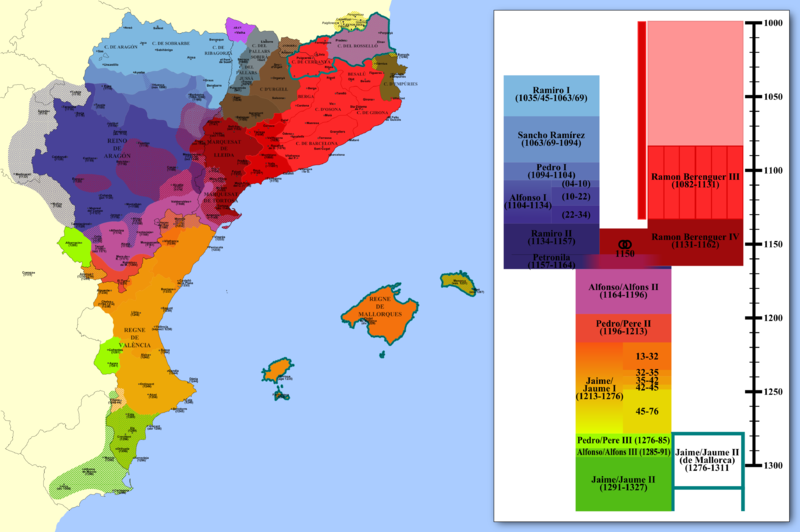
In 1137 Ramon Berenguer IV, count of Barcelona and ruler of Catalonia, married the heiress of the kingdom of Aragon – Petronilla. The union that came from this marriage benefited the Catalonians, which enabled them to expend knowing that the defense of Catalonia from Castile will fall on Aragon. At 150, the kingdom of Aragon gave the name to the Crown of Aragon, which will later rule Catalonia, Majorca, Valencia, Sicily, Naples and Sardinia. In 1179, the kingdom of Aragon signed an agreement with Castile. This agreement divided the Muslim held territories in two zones, one for each kingdom. In 1238 Aragon conquered Valencia, completing the agreement with Castile. After the conquests of Valencia with the help of the Catalonian see power, they started conquering the Mediterranean area. In 1282 Peter III of Aragon (1276-1285) helped a rebellion against Charles I and the Angevin king. After the massacre of 2 000 French inhabitants in the city of Palermo, the night of 30-31 March 1282, all of Sicily revolted and sought help from Peter, who landed at Trapani on 30 August the same year. Peter the III of Aragon was received as king by the Sicilians, so Sicily was ruled either directly by the king, or by his relatives. James II of Aragon, son of Peter III, gave up on Sicily and made peace with the Angevins and their allies with the treaty of Anagni in June 1295.

In 1320, Sardinia became part of the Aragonese Empire. In the time of the rule of Alfonso V of Aragon (1416-58), Navarre came under Aragonese rule in 1425, and after a long struggle so did the Kingdom of Naples in 1442.
After the extinction of the house of Barcelona in 1410, in 1412 Aragonese nobles procured an election of a Castilian prince, Ferdinand of Antequera to the Aragonese throne. One of Ferdinand’s successors, John II of Aragon, arranged for his son Ferdinand to marry Isabella, the heiress of Henry IV of Castile. After the death of John II in 1479, the kingdom of Aragon and Castle were united. However the Aragonese lands remained autonomous until the early 18th century when their constitutional privileges were abolished by Philip V.

