


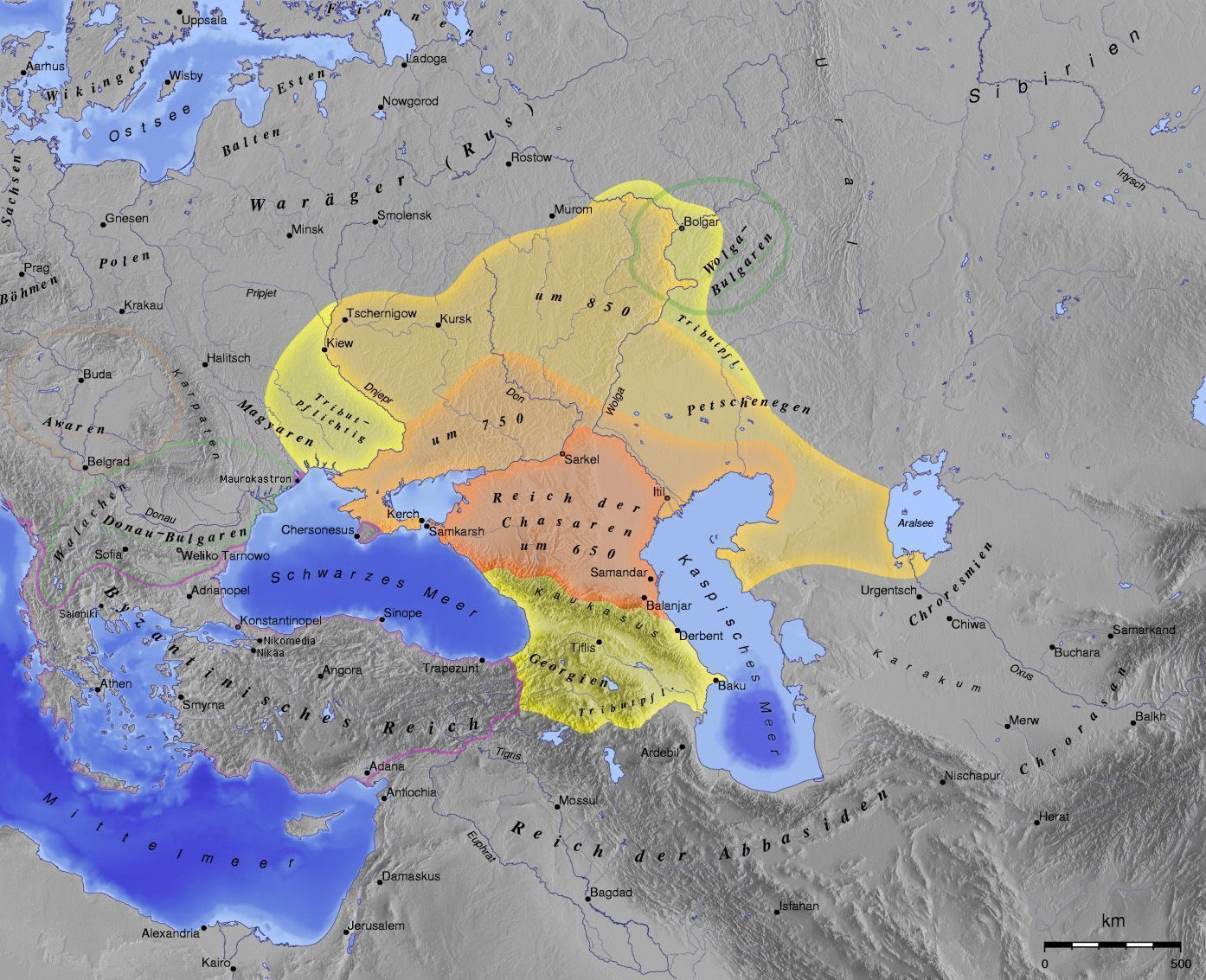
The name of the Khazars is a self given name, its etymology is not completely clear. According to one version, it comes from the Turkic base kaz – denoting roaming. The Black and, more rarely, the Sea of Azov were called Khazar (at that time the influence of the Khazars in the Crimea was very strong). Also, the name Khazar in the Middle Eastern languages is called the Caspian Sea (see Khazar Sea ). On land, the name “Khazaria” lasted the longest in the Crimea and the northern Black Sea coast where in Byzantine and Italian sources it lasted until the 16th century.
History
Until the VII century, the Khazars occupied a subordinate position in the nomadic empires that succeeded each other. In the 560s, they became part of the Turkic Kaganate, after the collapse of the latter in the middle of the 7th century, they created their own state, the Khazar Khaganate (650–969), which became one of the most durable nomadic associations in the region.
Originally inhabited in the region north of Derbent within the modern lowland Dagestan, the Khazars began to settle in controlled regions: in the Crimea, on the Don, and especially in the Lower Volga region, where the capital of the state was transferred in the VIII century. Several groups of Khazars as a result of long wars against Iran and the Arab Caliphate were forcibly resettled in the South Caucasus. Later, many high-ranking gulyams of the Abbasid Caliphate were of Khazar origin. It is also known about the existence of the Khazar garrison in Constantinople and the Khazar-Jewish community in Kiev (the Kozary tract exists in Kiev to this day). In the first half of the 9th century, three Khazar clans, called Kawaras, left the country because of political feuds and joined the Hungarians, with whom they came to Pannonia and subsequently assimilated.
The social organization as a whole did not differ from similar ethno-political formations of nomads, but progressively evolved with the development of statehood. Initially, the elected rulers gave way to the hereditary kagan dynasty, which, in turn, was replaced by the diarchy of the kagan and the bek. By the 10th century, the Khazars had moved from the nomadic way of life to the semi-nomadic, spending their winter time in the cities.
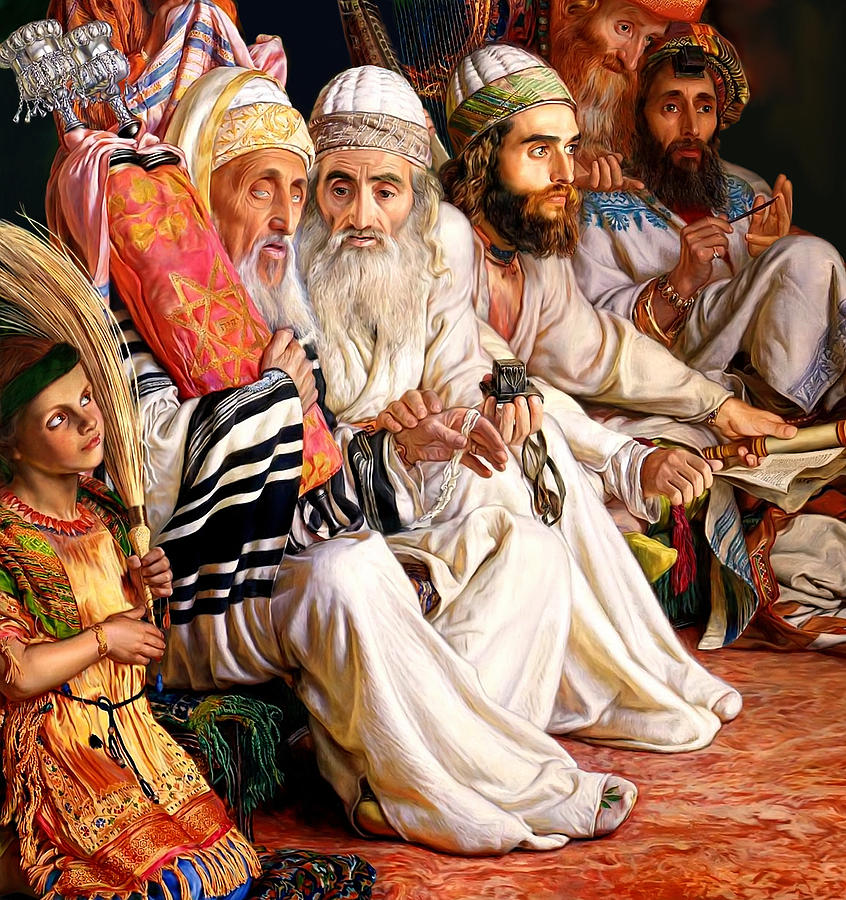
Religious beliefs consisted of common Turkic pagan rituals, which featured the worship of the god Tengri and the deification of the kagan. Due to the geographical position and tolerant policy of the government, Christianity and Islam intensively penetrated the Khazar environment. In the VIII — IX centuries. Part of the Khazars, led by the ruling family, was converted to Judaism.
A common for the Khazar Khaganate is the Saltovo-Mayak archeological culture, but the monuments that are firmly connected with the Khazars proper have not yet been identified.
Disappearance, possible descendants
After the fall of the Khazar Kaganate in the second half of the 10th century, the Khazars dissolved into the environment of the Turkic – speaking nomadic peoples, who later became part of the Golden Horde.
Some of the ethnic Khazars who practiced Judaism, in all likelihood, became part of the Central European Jewish communities. Some representatives of the Turkic-speaking Jewish peoples, the Karaites and the Krymchaks, as well as the Iranian-speaking mountain Jews, see themselves as descendants of the Khazars. Khazar roots may have some peoples of the North Caucasus.
The problem of the descendants of the Khazars is the subject of various theories and speculations in popular literature.
Sources:
Artamonov M.I. The History of the Khazars
Zakhoder B.N. Caspian collection of information about Eastern Europe
Ivik O. , Klyuchnikov V. Khazary
Koestler A. Thirteenth knee: The collapse of the empire of the Khazars and its heritage

