


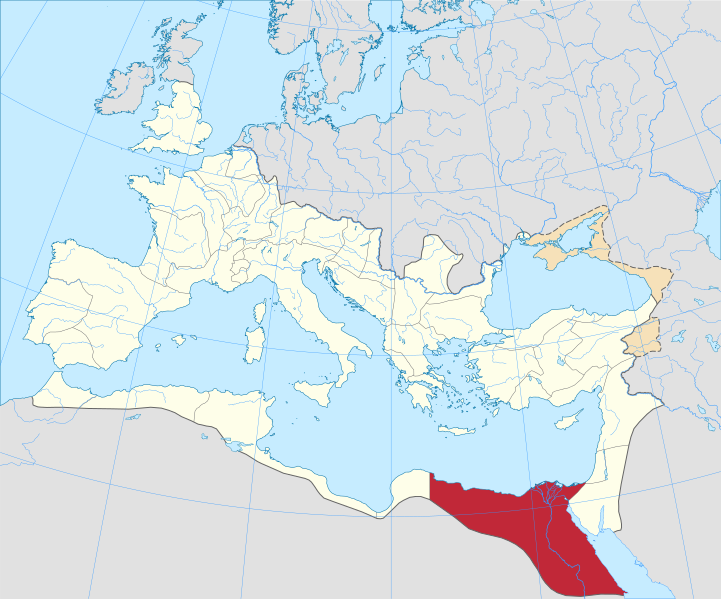
After the death of Cleopatra VII, the last pharaoh, Egypt fell under the direct control of Rome. The first contact, between Rome and Egypt, had occurred much earlier, in the time of Ptolemy VI. During his reign, Egypt was threatened by Antiochus IV, a Seleucid king. Antiochus’ army was closing on Alexandria. Ptolemy VI received help from Rome and managed to regain control. Later, Ptolemy XI awarded Cyprus to Rome, and in return, the Roman general Cornelius Sulla placed him on the throne. After the Battle of Pharsalus in 48 BC, the defeated general Pompey sought refuge in Egypt, but Ptolemy XIII had him executed, hoping that he would win Caesar’s sympathies. However, this backfired, and Caesar stayed in Egypt, supporting Cleopatra VII against him. Egypt became a client-state to Rome, but it was still self-governed. After Caesar was killed, Cleopatra sided with Mark Antony against Octavian, but they were defeated, and Cleopatra committed suicide in 30BC. This ended the Ptolemaic dynasty, and Egypt became Rome’s “breadbasket”.
Egypt was governed by a prefect who answered directly to Octavian. Even Roman senators were not allowed to enter Egypt without the permission of the Emperor. Three Roman legions were stationed in Egypt. Not much was changed in the cultural and religious life of Egypt, though an imperial cult was added. Priests kept most of their privileges. The prefect Aelius Gallus led an unsuccessful expedition in Arabia from 26-25 BC, and the next prefect, Petronius, led two expeditions into the Meroitic kingdom c. 24 BC. In time, Egypt’s borders were secure enough, so that one legion could be removed. Though Alexandria was deeply influenced by Greek culture, Egyptian traditions and religion continued to flourish in the rest of Egypt until the 4th century, when Christianity had a big impact. It is believed that St. Mark is the traditional founder of the church in Egypt, but it is still debated how many Christians were in Egypt until the 4th century.
Egypt remained very important to Rome. Vespasian, Hadrian, Septimius, Severus, Diocletian, all of them visited Egypt for different reasons. Vespasian was first proclaimed Emperor in Alexandrina in 69 AD. There were also many insurrections, one during the reign of Caligula (37-41 AD) between the Jewish and the Hellenic population in Alexandria. Another revolt started when Trajan (98-117 AD) was emperor of Rome and again in 172 AD which was ended by Avidius Cassius. In 293/4 a revolt broke out in the town of Coptos, put down by Galerius. These revolts continued until the end of Roman rule over Egypt. In 270 AD, Egypt was invaded by Queen Zenobia of Palmyra. Palmyra was an independent city on the border of Syria. She beheaded the prefect, but in 271, she was defeated by the emperor Aurelian.
The last Roman emperor to visit was Diocletian, in 302 AD. Major changes in Rome had a major impact on Egypt. The founding of Constantinople in 330 AD undermined Alexandrians traditional position, and much of Egypt’s grain ceased going to Constantinople. The cessation of persecution of Christianity meant that the religion could freely expand. The church soon dominated much of religious and political life in the Empire and in Egypt. The patriarch of Alexandria became the most influential figure in Egypt. In time, a rivalry manifested between the Alexandrian patriarch and the patriarch of Constantinople.

The rise of Islam meant new changes in Egypt. In September 642, the Arab general ʿAmr ibn al-ʿĀṣ marched into Alexandria, ending the Byzantine rule of Egypt and starting a new Islamic era.
Sources:
- Kovelman- “The History of the Ancient World”, vol. 3

