


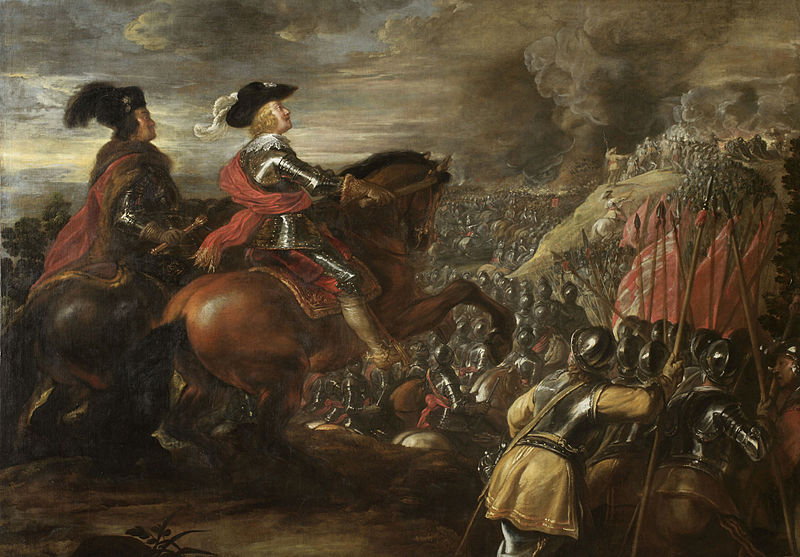
The Battle of Nördlingen was fought on September 6, 1634. It was one of the key battles of the Thirty Years’ War. The battle was fought between Sweden and the Heilbronn League against Spain, the Holy Roman Empire, and the Bavarian League. The battle led to a victory and new strengthening of the Habsburg (Catholic) position and French entry into the war.
At the time, the overall balance of power between the Habsburg coalition and Protestant troops in Europe was characterized by the continued weakening of Sweden (the conclusion of which was the death of the Swedish King Gustav II Adolf in the Battle of Lutzen on November 16, 1632), and the existence of serious prerequisites for consolidation of the forces of the Spanish and Austrian Habsburgs.
The city of Nördlingen was besieged by the imperial army under the leadership of the King of Hungary, Ferdinand (future emperor of the Holy Roman Empire Ferdinand III) until the end of August 1634. The forces of the Protestant army, led by Duke Bernhard Saxe-Weimar and Marshal of Sweden Gustav Horn, attempted to lift the siege. By the beginning of September, 1634, Ferdinand received reinforcements in the form of troops led by the brother of King Philip IV of Spain, the governor of Milan, and the cardinal infantry of Don Ferdinand of Austria. The army of Ferdinand of Austria was mainly Italian and Flemish cavalry; and German, Italian and Walloon infantry. The Spaniards were about one-fifth of the troops. The United imperial army under the consolidated leadership of Ferdinand of Hungary and Ferdinand of Austria had a force numbering about 30,000. The Protestant army was smaller and had about 20,000. The Habsburgs’ forces were located on the heights in the wooded area behind the besieged city. Their opponents were outside of the forest.

Course of Battle
The concealment of the deployment site of the Habsburg coalition forces forests, near Nördlingen, predetermined the fateful decision by the commander of the Protestant troops, Marshal Horn, to make their way to the city through the imperial ranks. Protestants began the offensive on September 6, 1634. The Swedish army, without its’ former discipline, suffered a severe defeat. The Protestants, after five hours of bloody battle , lost 3/4 of their army killed or captured. After this serious defeat, the Swedes were out of the war and had to retreat to the north.
Results and Implications
The results of the battle had ambiguous short-term and long-term effects. Tactical results of the battle were more likely to benefit Catholics than Protestants, namely the displacement of Swedes from southern Germany by the forces of the Habsburg coalition and the acceleration of negotiations between the Habsburgs and the largest ally of the Swedes, the Elector of Saxony. They ended with the Prague Peace on May 30, 1635. The politically important concession of the Emperor was the most important condition for the achievement of the Empire and Saxony; Ferdinand II’s refusal to carry out a repressive Restorative Edict of 1629 in Saxony for 40 years.
Strategically, the consequences of the Protestants’ defeat were contradictory. On the one hand, the general political situation after September 6, 1634, as in the first two periods of the war, began to favor Catholics. Thus, the conditions of the Prague Peace were “open”: any German principality could join the treaty, thereby abandoning any military confrontation with the Habsburgs and guaranteeing a temporary postponement of the restitution process to Catholics of property taken by Protestants since 1552. This temporary suspension of anti-reform measures was a new tactic of the Habsburgs and was designed to split the camp of Protestants. Over time, it began to bear fruit: coupled with the parallel actions of the imperial and Spanish troops, which began after the victory at Nördlingen, and with the methodical devastation of the lands of Protestant princes, it spurred the latter’s intentions to stop the hostilities. The North German Protestants began weakening the forces of the anti-Habsburg coalition.
On the other hand, the sharp weakening of the Protestants and the strengthening of the Habsburgs after the defeat at Nördlingen, could have brought about the growing hostilities with France. In early 1635, Olivares openly notified the Spanish State Council that war will be declared against France. “It is clear that if the Protestants fail, the war of Habsburgs against France is reality,” wrote Cardinal Richelieu, receiving news of the battle five days later in Paris. This led to an open speech by Louis XIII siding with the Protestants. Since all other reserves in the struggle against the Habsburgs were exhausted, on May 19, 1635, France sent an official herald to Brussels, announcing the beginning of military actions of France against Spain. A month later the French and Dutch armies invaded the Southern Netherlands controlled by Spain. In addition to the direct conduct of hostilities, France also intensified diplomatic efforts aimed at combating the Austrian and Spanish Habsburgs. The whole combination of these measures, coupled with the exhaustion caused by the longstanding confrontation of the opposing sides, determined the growing predominance of the French and Swedes, clearly marked during the fourth (French-Swedish) period (1635-1648) of the Thirty Years’ War.

