


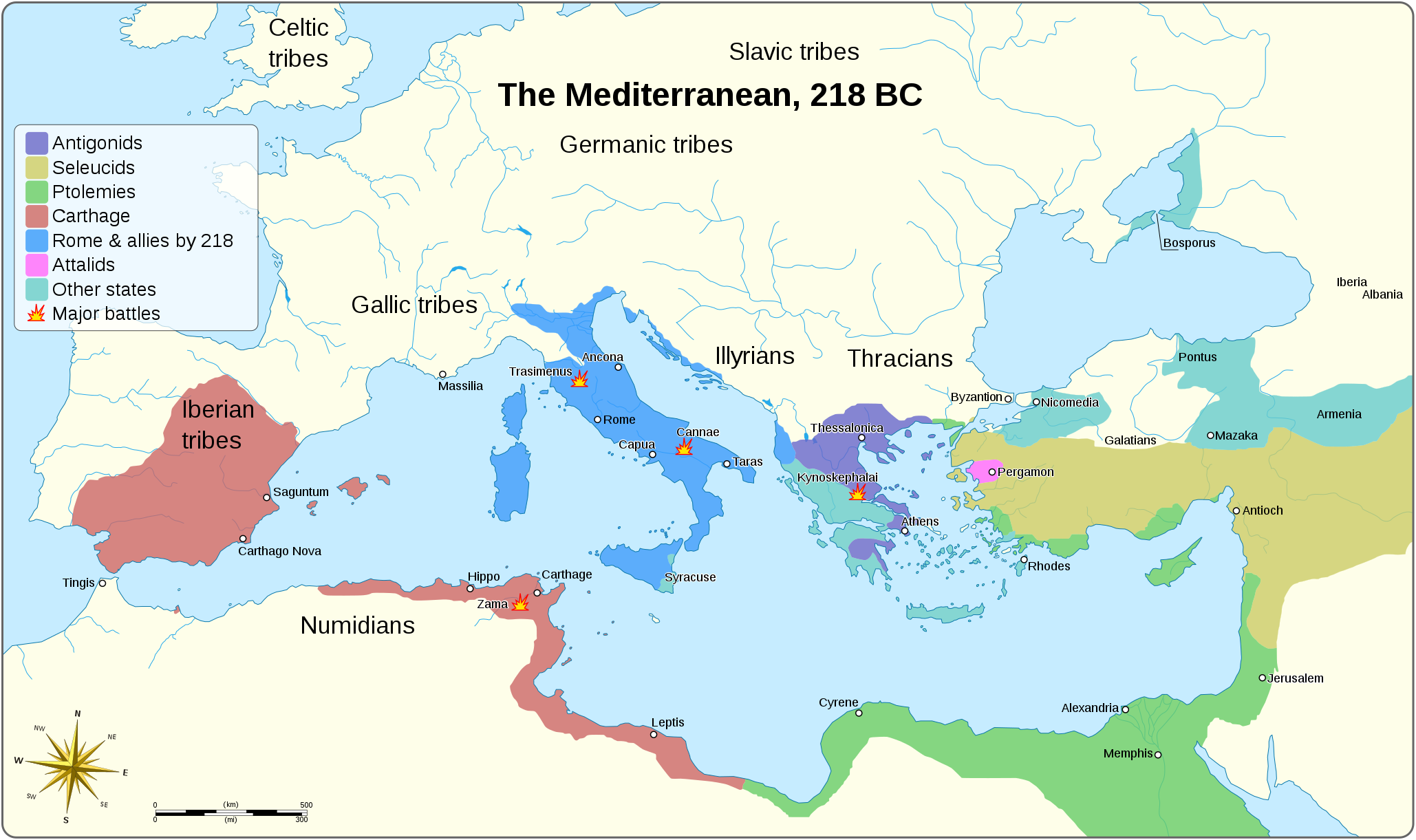
First Illyrian War
In the 30s of the III century B.C. after the victory of Rome in the I Punic War, the Roman maritime trade intensified. However, commerce badly suffered from piracy on the Adriatic, which was also facilitated by the natural conditions of Illyria: a winding coastline with numerous islands and convenient bays, which allowed local residents to raid the shores of the Balkan Peninsula and Italy, moving across the Adriatic and Ionian seas.
On the basis of this, the local tribes began to unite into a single state that flourished under King Agron 230 B.C. he captured part of Epirus, Epidamn, the islands of Far and Corfu and sought further north. To defend against possible attacks, the monarch formed an alliance with the king of Macedonia, Demetrius II.
The Senate sent ambassadors to Agron demanding to stop the looting of Italian merchants, during the negotiations they quarreled with his second wife Teuta, and on the way back one of them was killed by pirates.
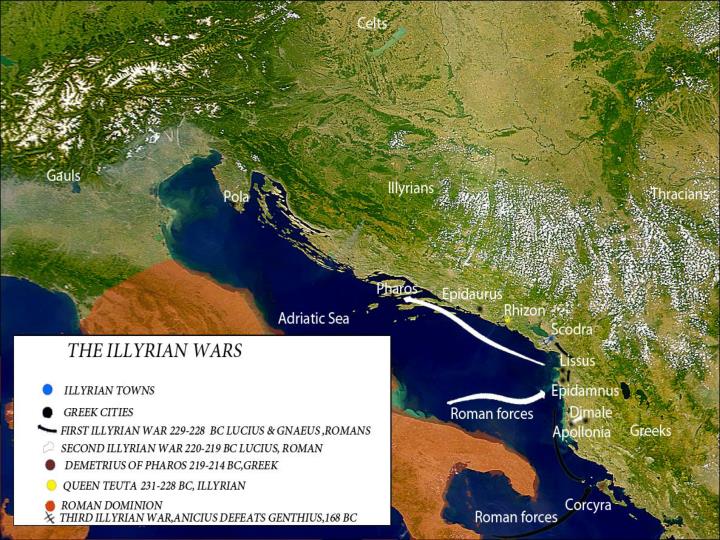
The Romans began the war simultaneously on land and at sea. At the beginning of the war, King Agron died, and his young son Pinn was in power, and Teuta was his regent. The Roman fleet of 200 ships appeared in eastern waters, and an army of 22,000 men landed near Apollonia. Macedonia could not help the ally because of the death of Demetrius II, who left Philip V, his 9-year-old son, as heir. Corcyra also appeared in the Greek fleet, to whom Demetrius of Faros, the Greek defender, passed the city. After that, the rest of the Greek cities of the Adriatic coast also surrendered under the protection of the Romans, and some of the neighboring barbarian cities expressed submissiveness. Teuta was forced to flee into the country. In the autumn of 229, one of the consuls with most of the Roman forces was already able to return to Italy, while the second was wintered in Illyria.
In the spring of 228, Teuta signed a peace, for which she refused the regions, cities and islands of the Adriatic coast seized by the Romans, pledged to pay a contribution and promised that the Illyrian ships would not descend south of Lissa (former north of the Strait of Otranto). Part of the territory of Rome transferred to Demetrius Faros, the remaining cities (Corcyra, Apollonia, Epidamna, and others), although considered “surrendered”, enjoyed internal autonomy and did not pay taxes, they were only required auxiliary troops.
Second Illyrian War
During the regency of Antigonus Doson, Macedonia was able to extend its power to almost all of the Peloponnese, which affected the actions of Demetrius of Faros after the death (or abdication) of Tevta, who became the ruler of her part of Illyria.
At the end of the 220s, he made an open ally of Antigone in Greece, and after zero reaction from the Senate, in 220 he pushed the pirate fleet to Greek waters.
The following year, the large Roman fleet and army reappeared in the Adriatic, under the command of both consuls. Macedonia was again unable to help its ally in this region, and Demetrius decided to start a war of attrition, deploying troops in fortified points. However, the Romans managed to quickly take his two strongest fortresses. after which he fled to Philip. His possessions in Illyria, apparently, came under the protectorate of Rome, similar to the events of 228.
Sources:
Eckstein, Arthur. “Polybius, Demetrius of Pharus and the Origins of the Second Illyrian War
Gruen, Erich S. (1984). The World of Rome: Volume II
Zock, Paul A. (1998). Ancient Rome: An Introductory History

