


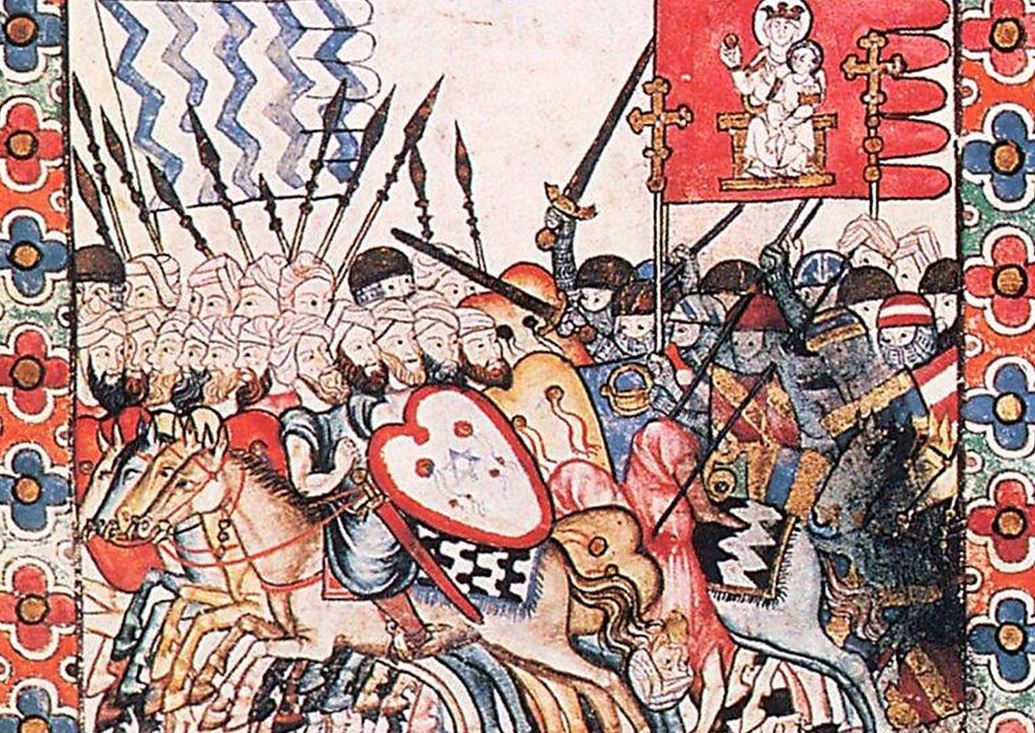
The Arab rulers of the Maghreb did not have a well-thought-out plan for the conquest of West Gothic Hispania. In fact, most of the population of the Maghreb, from where the conquerors came, were then made up of Berbers, who had only recently begun to convert to Islam. Berbers repeatedly raided the southern Iberian Peninsula after the fall of Roman power. There is evidence that on April 27, 711, Tariq ibn Ziyad, with 9,000 of his soldiers, landed in Iberia with the aim of making another large-scale predatory raid, taking advantage of the split in the West Gothic kingdom to the western part (rorigists) and the eastern part (viticans). The predatory version is indicated by the fact that his vessels resembled merchant ships, and when it became clear for what purpose these “traders” arrived, the Christian residents of nearby cities abandoned their property and tried to hide in the hills, that is, they acted as usual regions in the case of a short pirate raid, not a siege. Tariq captured Algeciras, and, waiting for reinforcements from Africa, moved further north, where on July 19, 711, the battle of Guadalete was fought, in which King Roderich was defeated. The West-Goth warriors, already small in number, were crushed. Only a small part of them took refuge in the Écija fortress near Seville, but she was soon forced to surrender. In the year 713, some resistance was exerted by the fortress of Mérida. Tariq made the invasion voluntarily, but, according to one version, after learning of the initial success of the Berbers in Hispania, Musa ibn Nusayr, an Arab governor from Ifriqiya, rushed to help, whose main goal was to consolidate the occupied lands of the Arab world.

Major Expeditions
The bulk of the land was conquered by the Arabs for the entire three years, from 711 to 714. During this period, Muslims organized three main military expeditions:
711-712: Tariq
712-713: Musa
714: Abd al-Aziz ibn Musa
By 719, the Arabs reached Toulouse, and by 720 – the Rhone Delta.
Christian resistance
In 714, after Abd-al-Aziz ibn Musa made his campaign against Murcia, the Visigoth commander Theodemir managed to agree on the creation of an autonomous principality here. The Umayyads made concessions, wishing, it seemed, to win the favor of local Christians. Theodemir’s kingdom lasted until the 740s.
Balearic Islands
The Balearic Islands, which nominally belonged to the Byzantine Empire as the remnant of the long-lost Byzantine Hispania, Justinian, initially remained aloof from the Arab invasions. In 798, the Franks gained power over them. Only in the year 902, after the stubborn resistance of the Christian population, the fleet of the Cordoba Emirate conquered the islands of Ibiza, Formentera and Majorca. In 903 Minorca fell. Despite the later conquest, the Islamization of the islanders was very deep.

Consequences
Muslim settlers began to arrive on the peninsula. At the same time, the few Arabs from Syria and Arabia chose the large cities in the south and southeast of the country, while the Berbers mostly settled in less favorable inland areas of the country. The Christian population survived, but numerous bans were imposed on them, emphasizing their second-best status. In the Christian environment, the process of consolidation of various ethnoreligious groups (Visigoths and Ibero-Romans) in the face of a common enemy gradually began. A number of Christians (muwaldas) converted to Islam in order to avoid jizya. The territories captured by Muslims (Al-Andalus) became part of the Umayyad Caliphate. However, already in 756, with the strengthening of proto-feudalism, an independent Cordoba emirate was formed here (756-929). In the northeast, in the valley of the Ebro River, by the end of the VIII century a buffer emirate of the Banu Qasi dynasty of the Muladi dynasty was formed.

