


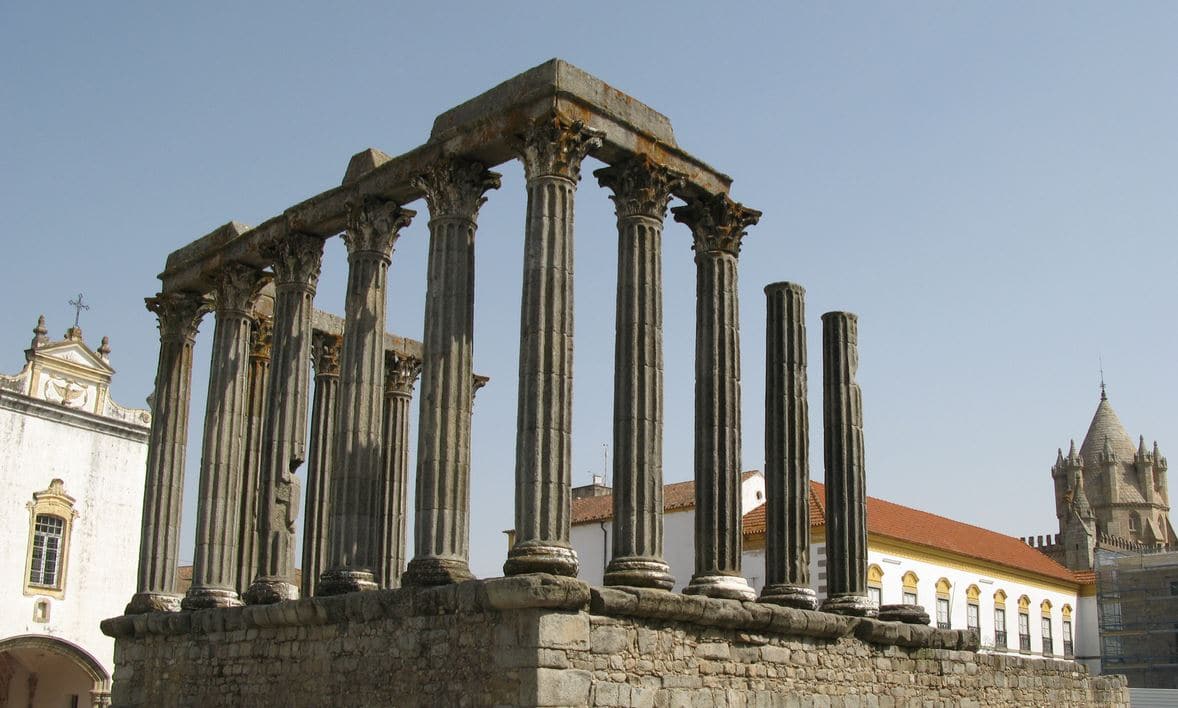
Lusitania (Roman province)
In Roman times, the history of modern Portugal is difficult to separate from the history of Spain.
In 159 – 135 years B.C. the Lusitanian war of the tribes against the Roman legions broke out.
The province of Lusitania was founded in 15 B.C. and occupied the territory of southern Portugal, known for its iron and silver mines.

Germanic tribes
After the fall of Rome in the territory of the future Portugal, from 409, the Germanic tribes of the Vandals ruled, then Iranian-speaking Alans migrated from the steppe regions of the Northern Black Sea Coast and the Don River Basin, and again the Germanic tribes, the Sueva, and then the Visigoths.
In 414, the Suebi concluded an agreement with the Roman government, under which they were given the right to settle on the Iberian Peninsula as federates, Galicia and a significant part of modern Portugal were ceded to them. The number of Svevs is estimated at 30 – 35 thousand people. In the early period of Suebian rule, the royal residences were Braga, Porto and Merida. Braga in the 6th century became the most important residence of the king. Since Roman times, Braga and Merida were important centers of Christianity, there were bishops there, and these cities are associated with the activities of Christian saints.
The history of the Suebi is traced according to the Chronicle of Idaqia until the year 469. Suebic cultural influence was insignificant, the language disappeared, leaving no trace behind. Most likely, the cultural influence of the Suebi was insignificant due to the small number of the tribe. Medieval Portugal saw itself as the heiress of the Visigoths, not the Suebi.
Visigothic king Theodoric II went to war with the Suebi, invaded Spain, and by 474 occupied almost the entire Iberian Peninsula, leaving a small part of northern Portugal and Galicia. The Svev State was conquered in 585 by Leovigild, after which it shared the fate of the Visigothic State.
Arabs
From 711 to 716, the tribes of the Moors (Arabs and Berbers) occupied almost the entire peninsula. The Arabs at that time were significantly superior to the Visigoths both culturally and economically. Arabs introduced irrigation systems everywhere, increasing the fertility of the land. Until the second half of the 9th century, the Moors occupied the whole territory of modern Portugal.
Reconquista began in 722. For a long time (up to the year 1000 ) the border was established along the Douro River, northern Portugal and Galicia remained Christian.
County of Portugal as part of Leon
Vassal from the Kingdom of Leon. The county of Portugal was founded in 868 by Vimara Peres – 868 is considered the first mention of Portugal as a fief, the foundations of modern Portugal. The territory of the county, consisting mainly of mountains, forests and marshes, was limited in the north of Minho, and in the south by the Mondego river. The name comes from the small port Portus Calais or Vila Nova de Gaia , now a Porto suburb, at the mouth of the Douro River.
Portuguese earls took an active part in the Reconquista and in revolts against royal authority. The highest influence of the county reached under Menendo II González, who became regent under King Alfonso V, the county later fell into decay and was transferred to Galicia.
The county was restored in 1093 by Alfonso VI of Castile as a fief for his son-in-law, Heinrich of Burgundy, this territory included the county of Coimbra, part of the province of Traz-montish and Alto Douro and the south of Galicia.
In 1139, the son of Heinrich of Burgundy Afonso I the Great proclaimed himself king.
Sources:
HV Livermore, A History of Portugal
History of Portugal / Jose Ermanu Saraiva

