


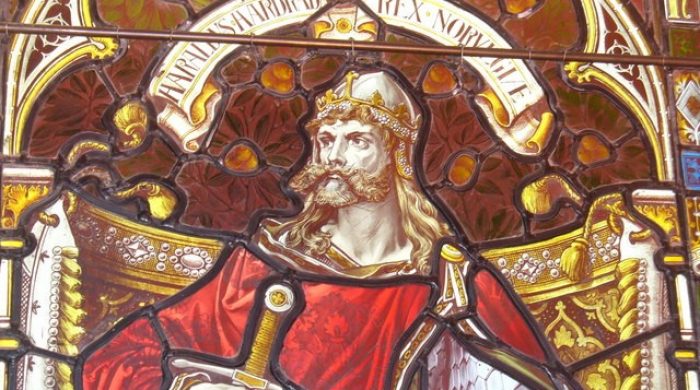
After coming to power, Hakon, brought up in the English court in a Christian spirit, tried to introduce Christianity in Norway, but met a serious rebuff from the bonds. He did not zealous, so the country remained pagan for several decades. The reign of Hakon, nicknamed “Good,” was accompanied by constant clashes with the sons of Eirik. In the last of them, in the battle of Fityar, despite the victory, Hakon was mortally wounded. The dying king, who had no sons, handed over power to his rival, Gray Skin, son of Eirik.
The new king had to contend with Hladir’s jarls, who did not want to obey the central government and enjoyed the support of the Danish king. In the end, Harald died, lured by the Danes into a trap. After that, the power in Norway passed to the Danish king Harald. He appointed Hakon the Mighty as his protege. He, however, soon broke with Harald after the Danes tried to introduce Christianity in Norway. Hakon was an ardent pagan and severed relations with Harald, and after he won the battle of Hjørungavåg, he actually became the independent ruler of the country. Despite the fact that, on the whole, Hakon’s reign is positively characterized, at the end of his life he displeased the bonds with his dissolute behavior. They supported the new aspirant to the throne – Olaf Tryggvason, a descendant of Harald the Fairhaired on his father’s side, and in 995 Hakon was killed.

Olaf Tryggvason managed what his predecessors failed to do, baptize Norway. However, this caused massive dissatisfaction with the bonds headed by the sons of Hakon the Mighty. They again turned for help to the Danes, and then the Swedes. In the battle of Svolder in 1000, Olaf fell. Norway at the same time remained a Christian country, but the Danish kings reigned in it again. Hakon’s sons, Svein and Eirik, ruled on their behalf.
The next Norwegian king was Olaf II of Norway, who was canonized after his death. Subsequently, he was given the title of “eternal king of Norway”. Olaf came to power against the background of discontent with the local population dominance of the Danes. He united all of Norway under his rule, rebuilt Nidaros, founded by Olaf Tryggvason and then destroyed, and made of it the capital of the state. Olaf the Holy resolutely fought against paganism, everywhere he implanted a new faith and pursued a policy of strengthening the power of the king. This led to a break with powerful bonds and a new uprising. After an unsuccessful military expedition to Denmark, Olav in 1028 fled to Sweden, gathered a new army, two years later returned to Norway, where he suffered a final defeat in the battle of Stiklestad and died. Norway came under the authority of the Danish king, Knut the Mighty , who appointed his son Svein as his deputy.
However, the Norwegian bonds again quickly grew tired of the Danish order. The same people who participated in the Battle of Stiklestad on the side of the Danes brought the ten-year-old son Olaf of Saint- Magnus from Novgorod and proclaimed him king. At first, Magnus was eager to squander with the murderers of his father, but in the end, in the interests of the unity of the country, he rejected this idea, for which he received the nickname “Good.” In 1042, Magnus inherited the crown of Denmark. Shortly before the death of Magnus, the stepbrother of Olaf the Holy Harald the Severe , who served in the Varangian squad, arrived in the country. Magnus and Harald showed prudence, did not clash, and divided the country. Soon Magnus died, leaving no offspring, and Harald became the ruler of all of Norway. In 1048 he founded Oslo.
The last major invasion of the Vikings in England is associated with the name of Harald the Severe. In 1066, under the pretext of an agreement on the right of inheritance on the English throne, Harald landed with a large army in northern England. Having won a number of victories, the Norwegian king fell into a trap and in the battle of Stamford Bridge with the Anglo-Saxon troops.
Sources:
Brockhaus and Efron Encyclopedic Dictionary
Danielsen R., Durvik S., Grönli T., Helle K., Hovland E. History of Norway. From the Vikings to our days
History from the Vikings to Our Own Times
Khlevov A.A. The forerunners of the Vikings
Kuznetsov A.Ye. History of Norway
Keizer, Jacob Rudolph . Norges Historie

