


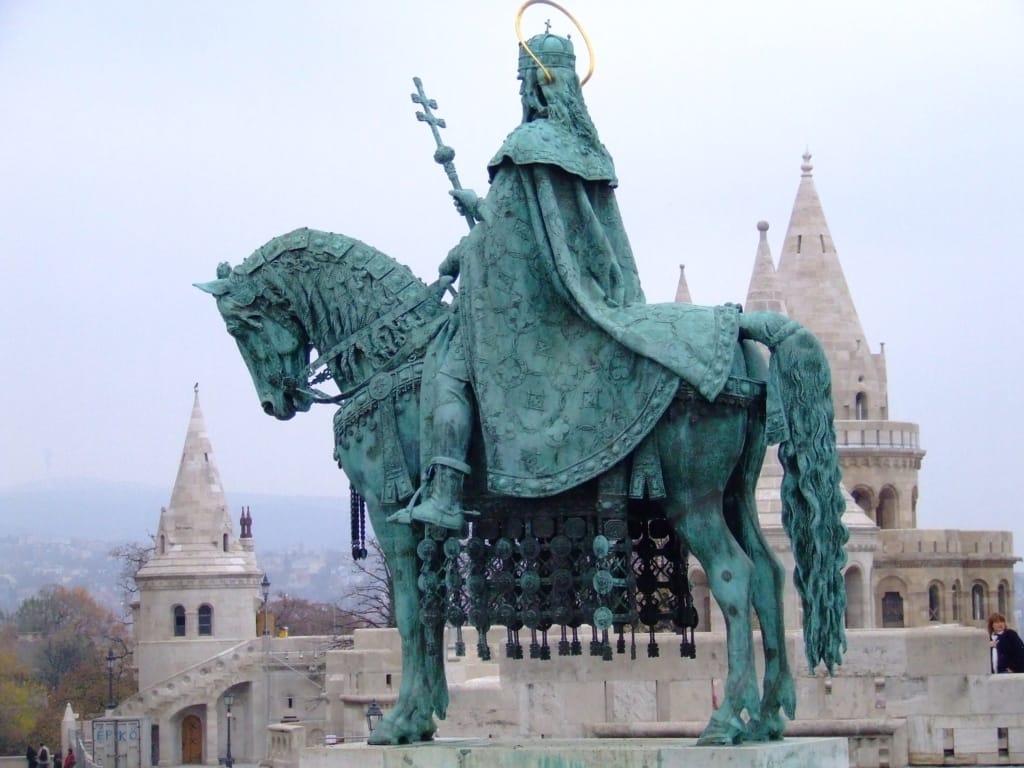
In 1000, the tribal prince Vayk adopted Catholicism, the name Istvan (Stephen) and the title of king. Istvan I (1000-1038) finally turned the Magyar alliance of tribes into a medieval European kingdom, divided the country into committees, at the head of which stood royal officials, the Ishpans. He zealously instigated Catholicism, suppressed the rebellion in Transylvania, introduced a set of laws, abolished slavery, and won the war with Poland for Slovakia. His nephew Peter Orseolo (1038-1041, 1044-1046), son of the Venetian doge, flooded the country with Germans and Italians, which caused discontent among the majority of Hungarians. The nobleman Samuel Aba (1041-1044), who relied on the pagans and poor peasants, brutally cracked down on representatives of the nobility, rebelled against Peter and took the throne. However, he failed to win the war with the powerful German king Henry III (1042-1044). Having suffered defeat, Samuel Aba was overthrown and executed.
Peter Orseolo, in gratitude for his help, pleaded vassal of Germany (1045). This caused indignation of the Hungarians, but the heir to the throne Vazul (Basil) was blinded in a scheme hatched by Gisela (the Queen of Hungary). Andrew I (1046-1060), married to the daughter of Yaroslav the Wise, Anastasia, and became king of Hungary. Andrew did not return to paganism, but soon launched a war with Germany. He successfully acted against the Germans with his brother Béla, to whom a third of the kingdom was given. But then the war began between supporters of Andrew and Béla, where the latter won a victory in alliance with Germany and the Czech Republic. Béla I became the king (1060-1063); the son of Andrew – Solomon escaped with his mother to Germany and three years later sat on the throne with the help of German troops (1063). The sons of Béla, Geza, Lampert and Laszlo, were forced to submit.
The new king was Solomon (1063-1074). In 1067, he successfully fought with Venice, supporting the Croatian ban Demetrius Zvonimir against her, who was married to Bela’s daughter Helena of Hungary. In 1068, Solomon defeated the invading Pechenegs in the battle of Kerlés, and in 1071, during the war with Byzantium, his troops took Belgrade. But soon the struggle between the king and his cousins resumed. In 1069, Solomon won the battle: Lampert fled to Poland, and Laszlo to Russia. In 1074, Solomon won against Geza, but Laszlo brought the Poles and the Czechs with him and in the battle of Mogyoród, inflicted a decisive defeat on the king. Solomon lost the throne and fled to the Pechenegs, until the end of his life he wandered along with the steppe inhabitants and unsuccessfully tried to regain power.
Geza I (1074-1077) was a zealous Christian, who restored relations with Byzantium; Emperor Michael VII in 1075 sent him a new skillfully made crown, instead of the one lost by Solomon during his flight. Geze was succeeded by his brother – Ladislaus I (1077-1095), nicknamed the Saintsfor excessive piety: the pope was even going to put him at the head of the First Crusade, only the death of the king prevented it. The reign of Ladislaus was successful, he forced the ousted Solomon to come to terms with the loss of the throne, repelled the invasions of the Polovtsy and the Pechenegs several times, and supported the papacy in the struggle against Emperor Henry IV. After the death of Demetrius Zvonimir in 1089, the brother of his widow Helena, made claims on the Croatian throne, captured Slavonia, and finally raised his nephew Almosh, the son of Geza I in Croatia. Another son of Geza, Kalman, inherited the throne after the death of Ladislaus.
Coloman (1095–1116), who received his nickname for his passion for literature (mainly theological), patronized the sciences and arts, issued two sets of laws, and officially banned the Vedovsk processes (“De strigis vero quae non sunt, nulla amplius quaestio fiat” – “There are no judicial investigations about witches, which really do not exist.”) During the passage of the Crusaders through his possessions, Coloman interrupted a whole detachment, which began to plunder the Hungarian lands, forcing the other Crusaders to observe discipline, and thus protected Hungary from ruin. In 1099, Coloman intervened in civil strife in Kievan Rus, supporting the Grand Duke Svyatopolk II against the Galician Rostislavich, but his army suffered a crushing defeat in the battle of Peremyshl from the Galicians and Polovtsy. But in 1102, Coloman finally annexed Croatia to the Hungarian kingdom, and by 1105 he conquered Dalmatia from the Venetians. Most troubles were brought to Coloman by his brother Almosh, who for a long time claimed the throne, calling for help either the Germans, the Czechs, or the Poles; In the end, Almosh was blinded by order of the king, along with his son, Bela.

The reign of Istvan II (1116–1131), son of Coloman , was filled with failures: Istvan lost the war with the Czech Republic (1116), with Venice (1116–1125), unsuccessfully invaded Volyn (1121–1123) which did not bring victory and lostthe war with Byzantium (1127-1129). Dying, he handed over the throne to his blinded nephew Bela, son of Almosh. Bela II (1131–1141) shared power with his wife Ilona (Elena Serbskaya) and her brother Belos, whom he appointed commander in chief. For several years they had to fight with another challenger – Boris, the grandson of Vladimir II Monomakh. Boris invaded Hungary for several years with the help of neighboring rulers, but he did not succeed. Under Bele II, the power of the Hungarians over part of Dalmatia was restored (1136) and Bosnia was annexed (1137). In 1139, the Hungarians intervened in the war between the Grand Duke of Kiev Yaropolk II in a war with the main rival – Vsevolod Olgovichand helped him in the siege of Chernigov.

