


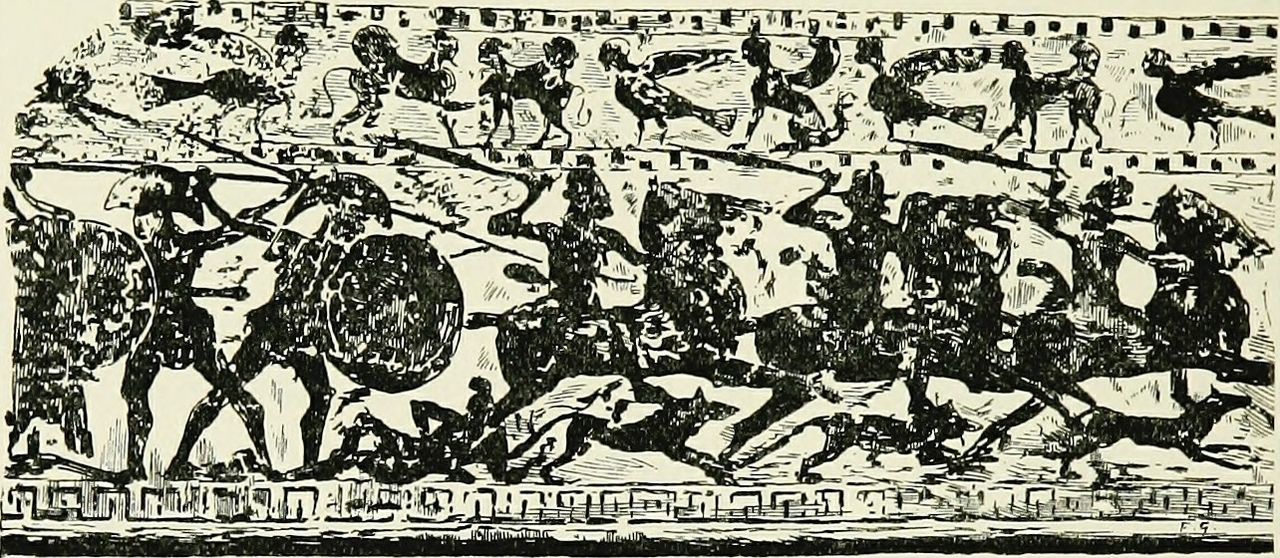
The Cimmerians are a nomadic Indo-European tribe that invaded Transcaucasia in the second half of the 8th century BC and in the 7th century BC conquered some areas of Asia Minor. Also, their name is the conditional name of the people of the Northern Black Sea region of the Iron Age.
The period of the ethnocultural community of the Cimmerians fell on the 1st half of the 1st millennium BC. According to ancient narrative sources and modern archaeological data, traces of Cimmerians are fairly reliably traced in the VII-VIIi centuries BC. The region of the Cimmerians’ residence in the North and East Black Sea (Crimea, Azov, Taman, Western Ciscaucasia and the Caucasus), and there is also information about the penetration of Cimmerians into western Transcaucasia and Asia Minor.
In the first millennium BC, the end of the Bronze Age and the beginning of the Iron Age came for the significant territories of Eurasia, including the region where the Cimmerians live. In this era, changes took place in public life: patriarchal-clan relations formed, large tribal groups were consolidated into significant tribal unions, patriarchal slavery arose, and inter-tribal and international economic and cultural ties expanded. The basis for this was the shift in the growth of productive forces: the process of domestication of useful animals was over, the cultivation of the main types of agricultural crops was completed, the economic basis of settled agricultural, nomadic and semi-nomadic cattle-breeding societies was being started, mass development of iron – one of the raw materials that played a revolutionary role in history of humanity.
Written testimonies of the Cimmerians were preserved among those who had written languages and directly come into contact with them: in the chronicles of the Assyrians, in the Urartian and Biblical texts, and some ancient authors.

About Cimmerians
The Cimmerians are nomadic tribes who penetrated the Transcaucasus from the steppe zone and were in 714 BC recorded by Assyrian texts under the name of the people “gimirru”. The data obtained from the analysis of the archives of Sargon II, Assarhaddon and Ashurbanipal say that in 714 BC Cimmerians are fixed in the area to the north or northwest of Lake Sevan, and in the previous period, they paid tribute to Urartu. King of Urartu made the trip to the nomads and suffered a major defeat. At the same time, the Cimmerians attacked the neighboring area of the Manna region of Washi, near Lake Urmia. After these events, the Cimmerians are not mentioned in the Assyrian texts for 35 years.
During this time, some of them moved to the western part of Asia Minor, and another group was near the eastern borders of Assyria. This Eastern nomadic group took part in the uprising of Kashtariti in 671-669 BC, as a result of which the Median kingdom was formed. Apparently, shortly thereafter, the eastern Cimmerians assimilate with the local population and disappear from the historical arena, which can not be said of their western tribesmen.
In the 660’s BC they strengthen the pressure on Lydia, as a result of which King Gig turned for help to Assyria. Soon the Lydians succeeded in defeating the Cimmerians, who for a time secured the kingdom. At this time, the nomads managed to tear off a number of western territories from Assyria, which made Ashurbanipal consider them to be very dangerous opponents. Strengthened, the Cimmerians, again attacking Lydia, as a result of which Sardis was taken. At this time, there is a unique clash between the Greeks and the Cimmerians, who managed to capture certain cities of Ionia.
Soon new attacks were made against Assyria, but during one of these campaigns their King Dugdammi died and the Cimmerians retreated. They are no longer mentioned in the Assyrian documents. In the Bible, Cimmerians are known as the Japhetic people of Homer.
One of the first mentions of Cimmerians is known from the “Odyssey”, probably created in the 8th century BC. In the poem traditionally attributed to the legendary Homer, the Cimmerians and their lands are characterized in the light of the mythological representations of the Hellenes and are located in the Far West near the world river-Oceans.
Archeology
Cimmerians is a term that often refers to the archaeological cultures of the Northern Black Sea region, dating back to the early Iron Age, respectively, and this time it’s called the “Cimmerian era” (XI-VII centuries BC). The origin of the Cimmerians is associated with the tribal cultures of the late Bronze Age. It should be noted that attempts to link the historical Cimmerians and the cultures in question are highly hypothetical.
Art
Most often in Cimmerian man made objects, there is a figure in the form of a diamond-shaped badge with concave sides and a circle in the middle. Almost always, this icon fits into a circle, resulting in a simple four-petalled rosette. Badges of this kind usually formed round bronze plaques with holes for criss-cross belts near the bridle. Based on the fine arts of neighboring peoples, they restore the clothing of the Cimmerians. They wore leather jackets, trousers, boots and pointed caps.
Language
At present, all the information about the Cimmerian language is highly hypothetical due to the fact that only a few names of their own in the Assyrian transcription have been preserved from their language, as well as the name of the people themselves. The self-name of the Cimmerians probably sounded like a “gimer” or “gimir”. There is also a version that the Cimmerians were close to the Thracians. According to some authors, the language of the Cimmerians could be a “lost link” between Thracian and Iranian.
Source:
- Artamonov MI Cimmerians and Scythians
- Homer
- Elnitsky LA Knowledge of the Ancients about the Nordic Countries
- Ivanchik A. I. The Cimmerians
- Cimmerians // Encyclopedic Dictionary of Brockhaus and Efron
- Lubker FG H. H. Cimmerians

