


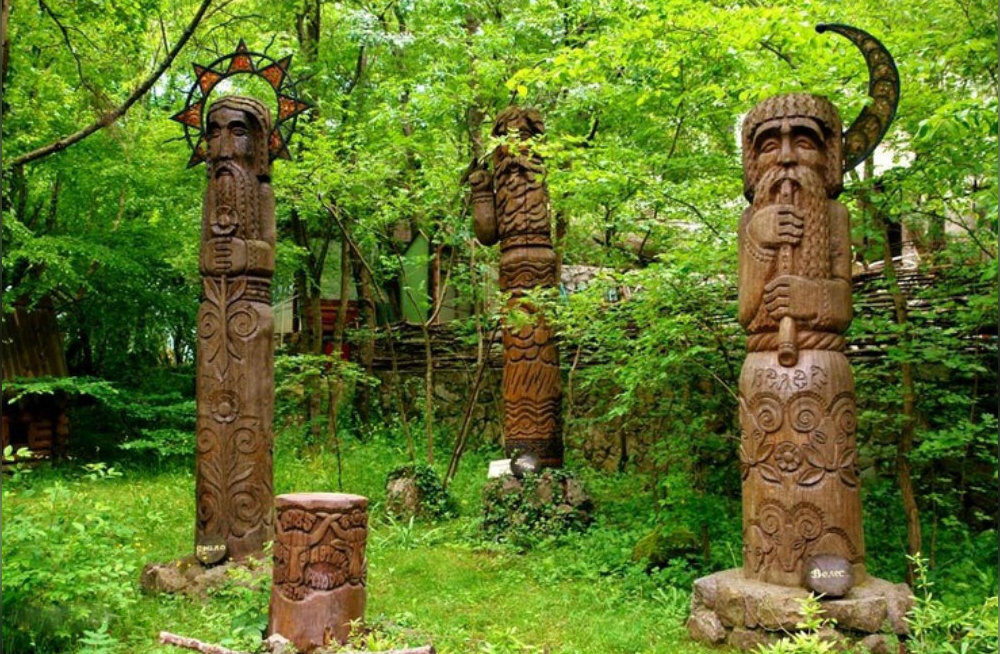
The pre-Christian religion of the Slavs is based on three primary sources. The first are written sources, which include classical writings, Arab travel accounts, Christian teachings discouraging the pagan religion, and medieval chronicles. The second source is the archeological finds, but debates continue over the identification of Slavic and none-Slavic cultures, the extent of migration and diffusion as opposed to autochthonous development . The third source is from folklore and ethnography, folk traditions, epic poems fairytales, ritual songs and dances. Many of these traditions are thought to have continued in modified and fragmentary forms as late as the beginning of the 20th century.
Slavic people believed in a wide variety of spirits who inhabited the rivers, forests, houses or were personifications of illness, weather, luck, fate etc. One of those spirits was Leshy, a forest spirit who assigns prey to hunters, and probably was the protector of wild animals, but in latter ages it became protector of herds. Slavic people believed in a tree spirit, who enters buildings through the wood from the trees used in their construction. Every building had a different spirit: Domovoy in the house, Ovinnik in the drying house, Gumenik in the storehouse and so on. Other known spirits are the Polevoy, a field spirit Vodyanoy, a water spirit. Seasonal festivals were organized to welcome the return of the ancestors or nature spirits in springtime and similar occasions.

A four-sided temple statue found near Zbruch in western Ukraine includes divine figures, probably gods on its top level, a human khorovod or ritual dance in the middle and a three-headed figure that holds the world from the underworld. This statue is closely related to beliefs of the Slavic World Tree that can be reconstructed from Slavic folklore. The tree is represented on three levels, the top as heaven represented by birds, sun and the moon, the middle as the earthly world represented by bees and humans and the bottom as the underworld represented by snakes or beavers.

12th century chronicles mention a few gods who were worshiped by Prince Volodymyr (Vladimir) in the late 10th century in Kiev. Volodymyr’s pantheon was established in the decades preceding Christianization. Volodymyr accepted Christianity in 988, but the pagan practices continued in the more isolated or northerly areas. One of them was the temple at Arkona on the island of Rugen (today in Germany), that was destroyed by the Danes in 1168. The Russian Primary Chronicle, a 12th century account of events in Kiev, mentions seven gods: Perun, Volos (Veles), Khors, Dazhbog, Stribog, Simargl and Mokosh, and a Russian glossary mentions another god Svarog . In Knytlinga saga (a Danish legend) there is a mention of another god Zcerneboch (Chernobog) which literally translated means “black god,” considered to be dark or evil. Perun was the god of lighting, law and war. In the Polish language, the word piorun, meaning lighting, is derived from the name of this god. Swarog was the god of the fire supporting the blacksmiths, Veles was the god of the underworld, Dazhbog god of the sun, Khors (Hors god of healing, Stribog god of winds and air, Mokosh god protector of woman. Other Slavic gods that can be found in folktales or other sources are: Svetovid- god of war who had four heads, Jarilo-god of youth, Lada-goddess of love, Rod-the god who created everything that exist, Belobog (White god)- god of light and the opposite god Chronobog, Triglav- three headed god local replacement of Veles. Human sacrifices also had a big role in Slavic religion.

