


The Volcano Thera
We know from geological and archaeological records that a major eruption of the volcano Thera (named after the largest remaining island in the Santorini group, which surround the caldera caused by Thera’s explosion) took place about 3500 years ago. Radiocarbon, tree-ring, ice-core data have shown that the date was probably between 1690 and 1620 BCE. This eruption has been blamed for
everything from the destruction of the Minoan civilization to the legend of Atlantis to the parting of the Red Sea by Moses. Chinese records speak of yellow fogs, cold weather, and floods now thought to have originated in the blast. The volcano continues to be active. It erupted as recently as 1950 and six years later a major earthquake in the region killed scores of islanders.
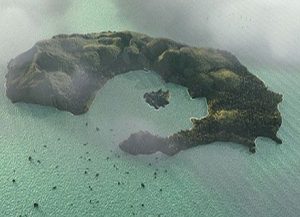
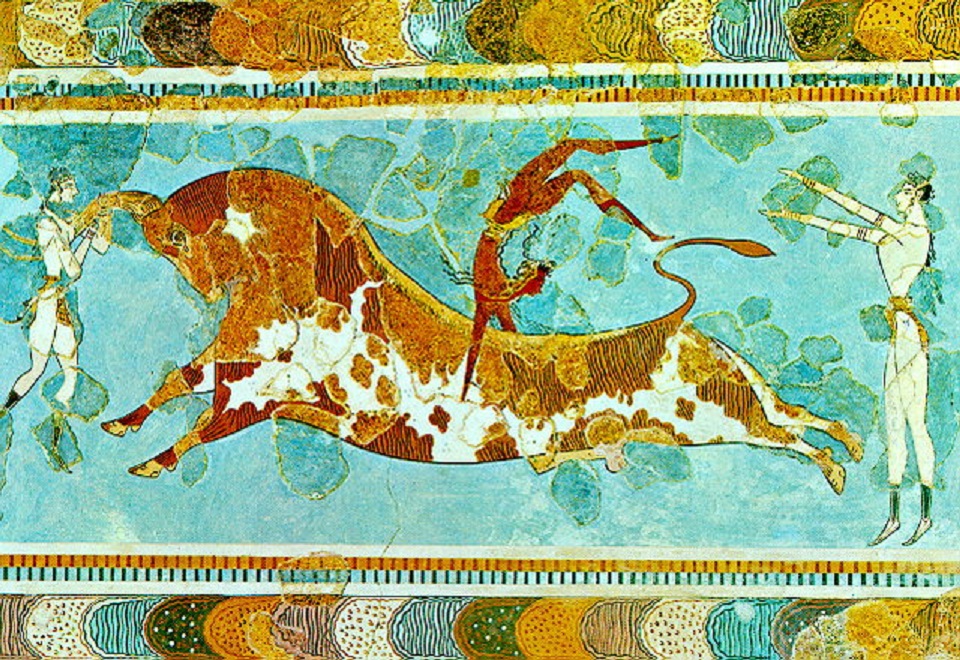
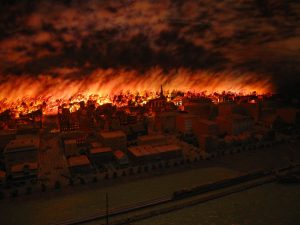
Thera is in the Mediterranean Sea, only 120 km (70 mi) from the island of Crete. The people who lived in Crete, starting about 2600 BCE, are known today as the Minoans, after King Minos, their legendary ruler. Shortly after 1400 BCE, according to archaeologists, the powerful Minoan civilization vanished and was replaced by a simple peasant culture. One theory holds that earthquakes associated with the Santorini eruption caused extensive damage to the Minoan palaces, especially from fires from lamps that were knocked over; a more recent theory credits the shock wave from the blast as overturning the lamps. The discrepancy between the date of the major eruption of Thera and the end of the civilization, with the eruption dated by geochemical and biological means but the end of the Minoans dated by linking pottery styles in Crete to pottery well-dated by written
records in Egypt, is hard to reconcile. The volcanic eruption of the 17th century BCE caused tsunamis 9 m (30 ft) high in Crete and dropped 10 cm (4 inches) of ash on the island, but the fires
apparently destroyed the palaces.
Atlantis
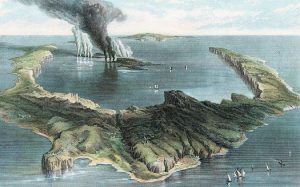
Atlantis was supposed to have been a large island west of the Strait of Gibraltar, in the Atlantic Ocean. Legend has it that Atlantis was the leading civilization of its time. Plato, whose two descriptions are the main source of the legend, wrote that “in a single day and night of misfortune, it sank into the sea.” Some scientists think that Atlantis was a large island where the Santorini group is today –– a theory first proposed in 1872. When the great eruption happened, the large island and everyone on it vanished. Today the former large island is the caldera filled with the sea. Another theory, which dates from 1909, is that Atlantis was Crete itself, which lost a great civilization, although the island was not replaced by the sea as Thera was.
Other stories from the Bronze Age have also been connected to the Thera eruption by various authors:
• A Greek flood myth, perhaps inspired by Thera’s tsunamis.
• Various events in the story of Jason and the Argonauts.
• The seven plagues of Egypt foretold by Moses, as well as the
pillar of cloud by day and fire by night that led the Exodus.
These all have plausibility, although each would be difficult to prove.

